Showing posts with label long bond. Show all posts
Monday, July 09, 2012
Career Reinvention Update
Long-time readers will recall that I used to trade the financial markets....and that I took a whooping shorting this insane bear market rally.
I've recovered from many an a$$-whooping in the trading account over the years (16+) but for variety of reasons it was time for a difficult career change.
Well I'm still in the process, HomeschoolDad.com is the main long-term business plan at the moment, but I've also been angling to break into the lucrative high-end tutoring market here in the NYC metro area.
Not in dire need of money, I've been holding out for precisely the kind of work I wanted.
And, finally, I'm starting to make some inroads.
Today I taught my first *competitive math* classes in a summer program here on Long Island.
Class is 4 straight hours and pays $320 cash....which while nothing like what I used to make selling a 100-lot of juicy puts back in the day, it still felt good. The thing is, I enjoy teaching math so much that I would almost do it for free. Almost.
The kids are young, 100% Asian, and well-behaved (so far).
In the future I hope to get my hourly rate north of $100 once my reputation as the *best math teacher on Earth* spreads...
And I'll also use this teaching position as an opportunity to build out my (math) info-products.
It's been a slow process, but things are finally looking up for me on many fronts.
Saturday, November 22, 2008
Marginalizing Gary Shilling
In his latest Forbes column, Gary Shilling writes:
Moreover, commodity prices are collapsing as global demand falls and as those who thought commodities were a legitimate investment rush out even faster than they charged in.
Okay, so in his opinion, commodities are not a *legitimate investment*.
So, Gary, what the heck is?
Mutual funds? Currencies? Your house? Floridian condos?
According to Rich Karlgaard, in this comment thread, Gary Shilling:
...has made the bulk of his returns, he claims, in 30-year Treasuries, which he rolls over every year.
Good luck with that one Gary! When the long bond market implodes I am coming at you with *Treasuries were never a legitimate investment*.
Thursday, October 09, 2008
Missed Opportunities
Just yesterday I contemplated shorting PNC and SunTrust Banks.
Look at them today:
STI -6.63 to 35.12
PNC -4.18 to 63.57
There's still meat on these bones but I'm reluctant to chase them, down.
Note also Wells Fargo is taking it on the chin today, -3.77 now, for a change. I needed that. I can't wait until their earnings call next week; I can't wait to hear their NEW ACCOUNTING LIES.
Surprise, surprise. Looks like the feckless manipulators allowed the *short sale ban* to end today without extension.
Wednesday, January 02, 2008
Marginalizing Investing

As I type this, just today gold is up $24 to $859 per ounce - near the 1980 record of $873.
Oil is up $3.50 to $99.59 per barrel.
The NASDAQ-100 futures are down 44.5 points - a monster decline.
The euro is up a full 150 basis points against the dollar.
And Treasury Bonds are screaming with the 10-year up a full point and the long bond up 1.5 points.
So I ask, why do so many people want to "invest" today when there are trading opportunities and volatility galore?
This generation's Warren Buffets will be traders. Buy-and-hold has been superseded by in-and-out.
Tuesday, October 30, 2007
Marginalizing Ben Bernanke

I am aware of the financial news scuttlebutt but twelve years of experience has conditioned me not to pay too much attention to it.
The other day, while idly watching my son at the park, I grabbed the only reading material I could find in my car - the April 2007 Futures magazine. (I DID NOT buy it. My buddy in Manhattan made me steal something from his contemptible roommate. This is just the type of service that I provide for my friends.)
Page 22 excerpts from Steven K. Beckner's Market Watch column:
Bernanke told the House Budget Committee there had been "no material change" in the Fed's economic forecast in the wake of the market slide and said he saw no "liquidity crunch" in the world or any breakdown in the workings of financial markets. He said he still expects moderate, if not improving, growth as the housing market stabilizes.
...Upside inflation risks, the Fed chief said, are the Fed's predominant concern.
Just to remind y'all the Dow dropped 416 points on Feb 27th, 2007. The media clowns attributed most of it to "subprime woes" but Wall Street roundly declared them "contained". Such was the backdrop to Bernanke's Congressional testimony two weeks later.
Let's fast forward to what we do know FOR A FACT today.
The other day, while idly watching my son at the park, I grabbed the only reading material I could find in my car - the April 2007 Futures magazine. (I DID NOT buy it. My buddy in Manhattan made me steal something from his contemptible roommate. This is just the type of service that I provide for my friends.)
Page 22 excerpts from Steven K. Beckner's Market Watch column:
Bernanke told the House Budget Committee there had been "no material change" in the Fed's economic forecast in the wake of the market slide and said he saw no "liquidity crunch" in the world or any breakdown in the workings of financial markets. He said he still expects moderate, if not improving, growth as the housing market stabilizes.
...Upside inflation risks, the Fed chief said, are the Fed's predominant concern.
Just to remind y'all the Dow dropped 416 points on Feb 27th, 2007. The media clowns attributed most of it to "subprime woes" but Wall Street roundly declared them "contained". Such was the backdrop to Bernanke's Congressional testimony two weeks later.
Let's fast forward to what we do know FOR A FACT today.
- Subprime mortgage problems have not been "contained"; they are actually proving contagious.
- August's market meltdown proves that the financial markets are prone to crunches of "liquidity". A liquidity crisis is not a singular landmine to avoid - it's an endless minefield. Or one can better think of it as a permanent gun pointed at the head of our financial system.
- Six months after his testimony, the "moderate growth" from a "stabilizing housing market" has not materialized. If fact we have been riding lower growth and a worsening housing market. What a sage!
- And back in April, with oil trading $64, soybeans trading $7.60, wheat trading $5.00, and gold trading $700 Bernanke was most concerned about "upside inflation risks". Yet today, on the eve of another Bernanke rate cut, gold is pushing $800, wheat is almost 70% higher, soybeans over $10, and oil is trading at $93 per barrel - I guess aside from the higher commodity prices, upside inflation risks can be brushed aside.

Remember when Bernanke dropped rates 50 basis points last month with the fierce intimation that it was "one and done"?
The guy is provably a walking monthly-contradiction of whatever he said last. Perhaps when oil is $100 a barrel he'll go back to worrying about "upside inflation risks"? In that case, you'll know to brace yourself for another "liquidity crunch"!
As I have said before, the hardest part about trading the financial markets is NOT UNDERESTIMATING the stupidity of all parties. For example, the Fed Chairman may well be a vacillating dolt, doing long term harm to our economy for short term feel-good, stock and bond upticks. Nevertheless, fund managers and sheepish investors (who should be farsighted) may go hog wild and bid up securities again after the inevitable rate cut tomorrow. I seemingly spend all my mental energy trying to figure out who the biggest Morons are, and how to bet against them.
It ain't so easy.
Friday, October 26, 2007
Trade Suggestion

Usually, when the really good, "no-lose" trades come up, my position is already so big that I can't add to it. That is the case now. Along these lines, I knew a veteran trader who always put his "5th buy" in his Keogh. Despite paying Merrill Lynch a sodomizing .09 per share in commissions, his retirement account grew by leaps and bounds.
I have been bearish on, and short, the 30-Year Treasury for a couple months now. I am down a good four points. If I was flush, I would hit it with a baseball bat today. Here's my reasoning:
The stock and bond markets have exploded since the August "credit crunch". As I have blogged on before, market participants are all betting on more rate cuts from the political animal (Bernanke) that runs the Federal Reserve. There's no doubt in my mind that another 50 basis point cut is baked into both stocks and bonds.

Here's the wrinkle: oil just shot up to $92 per barrel today and the dollar is at a new multi-decade low. These are the only developments that MIGHT prevent those inflating idiots from dropping rates to "save" an unsalvageable housing market.
Ergo, markets shouldn't have a 100% likelihood of a cut priced in. Oil could very easily be $100 next week and this dollar weakness could cause an international run on our currency. As much as these politicians would like to artificially prop up asset prices, Bush's poll numbers, and their perceived re-election chances, they may in fact be forced to stand down and do something they've never endeavored before. They may have to sit back and do NOTHING. What a notion!
That's why I see shorting the long bond as very good bet TODAY.
For my mind it sets up as an ideal trade.
- My best trades in the past 12 months have been shorting sharp upticks in the long bond. My first whack came when the clowns bid it up after the '06 election victory of the socialists. The second time was this past March when it popped to just about these same levels for seemingly "no reason". A good trader sticks with what's worked.
- I believe the long bond is tired and at the end of a multi-decade uptrend. It's been ignoring ubiquitous inflation since 1998. In the old days, all it cared about was inflation. $90 oil and $10 soybeans should at least take a bite out of bond euphoria. So without even talking about the built-in tax increases and ticking entitlement bombs I see plenty of fundamental weakness to comfort me on the short side of bonds.
- And as I mentioned above, there has been, what I perceive as a ridiculous, non-sensical move in bond prices. There's nothing more salivating than an insane uptick in a downtrending security. This not only gives an ideal entry point, it usually provides a rapid profit.
One can short the futures with very little money down. It's a 113 dollar number with minimum increments of $100,000. In other words, if you short one contract at 113 and buy it back at say 109, you would make $4,000, that would be one grand per point. To put it perhaps more simply, shorting one future's contract would be like shorting 1,000 shares of a 113 stock.
BUT, to short 1,000 shares of a 113 dollar stock one would need at least 50% of it as margin, i.e. $56,500. Whereas, shorting a long bond future only requires something like $2,000 worth of margin. (I would recommend you have $5,000-$6,000 as your mental "loss" provision).
So shorting the long bond is a cheaper, less risky way for the small investor to play the commodity bull market.
I will revisit this trade suggestion, hopefully very shortly and at lower prices.
Friday, September 07, 2007
Wall Street Bets All-In on Fed's Stupidity

This just came across the wire.
Goldman Sachs says expects 50 bps rate cut from Fed at Sept 18 meeting after weak jobs report
Of course, Treasuries have been rallying for weeks now. I don't know how this isn't already priced into a nose-bleeding 30-year Treasury that only yields 4.71% as I type this.
I am short this bond and bleeding - badly.
Who in their right mind would lend money to our government, for 30 years, at a rate of 4.71%? Even if we do go into a Japanese style, low-growth recession short term rates may stay low for what 2-5 years? What about the other 28-25 years? A 30-year instrument should not be valued by 2-5 year outlooks. Isn't that what American homebuyers are suddenly learning?
The fact that our government is about to drop short-term interest rates with gold, oil, and wheat setting all time highs is sheer lunacy. Historians will look back with bewilderment, just as we do when studying government "remedies" during the Great Depression.


There is no pressing reason for the government to drop rates. It won't help homeowners for more than a fleeting moment. It won't help the economy in the long run. Politicians are just too stupid and too spineless to do the right thing - which is nothing. Let economic forces run the economy on their own. Remember, the federal government played a starring role in the housing bubble in the first place - by dropping rates so much in the early 2000s.
This bailout is going to finally bite them in the ass.
Some boats are meant to sink.
Friday, August 17, 2007
Flight To Insanity

For those of you not paying attention, financial markets have been in turmoil these past four weeks. The Dow has shed over 1,000 points and Nasdaq has had a near 10% correction. All of it (ostensibly) stemming from hiccups in the mortgage market.
Everything is going down, down, down. Commodities and even gold THE hedge (theoretically) against all monetary crises for the past 4,000 years.
One asset that is rising amidst this storm is the US Treasury market - and it makes zero sense.
It's deemed a "flight to quality" by sheepish clowns everywhere - but from where I sit, it's purely insane AND I am shorting heavily into it.
Let's go back to June when the long bond got smacked and its yield touched 5.40% (up from December's low of 4.50%). That idiot Bill Gross was calling it the end of a 25 year bull market in bonds. Thankfully I covered my short at that plateau (of course I re-established it at better, albeit lower than today, prices).
I agree with him in principle that bonds are about to wither and die, but in trading markets, timing always reigns supreme.
I believe this uptick in the 30-year presents the "whacking" opportunity of a lifetime. It's profoundly irrational that petrified credit buyers are fleeing one bubble (mortgages) for another, even bigger, bubble (30-years).
If Gross, and yours truly, are correct that bonds are entering a prolonged bear market, then this insane rally is begging to be shorted into - and that's what I have been doing.
I see the bond like I saw California real estate in '04-'05. Anyone not irretrievably myopic could see that "Fruit and Nut Land" was a fiscal and social disaster on the brink. Screaming real estate prices were a godsend to wise Californians looking to move out - and many did.
On other blogs I have recently made the point that the best way to play a bounce in equities is to short the long bond. I think its ceiling is firmly in place - with socialists ascendant, built-in tax increases coming (AMT, expiring low rates on capital gains and dividends, etc.), protectionism in the air, rising commodity prices, deflating housing (which is inflationary), ticking entitlement bombs,...)
Take a good look at this long term chart.

It sure makes "reversion to the mean" a very scary thought for many - although a pleasant thought for me and my fellow shorts.
Wednesday, June 13, 2007
Perma-Optimism Dementia

You needn't enlarge the pic. Here's what Steve Forbes said about housing in the June 18th, 2007 issue.
Thanks to Fed-created inflation, housing prices in most of the country will firm and then rise. This won't save overextended subprime lenders and most come-lately speculators. But it will give much of the industry something of a second - albeit brief - wind.
Housing will "firm" and then "rise"?
Say what?!?!?!
The recent demise of 30-year Treasuries just shaved more than 5% off the value of every piece of real estate in the nation.
So much for a bounce!

Steve Forbes is a formidable intellectual but his puerile analysis on housing shows that an unshakable optimistic bias can be just as distortionary as its opposite.
(Steve's been bearish, and very wrong, on oil prices for a few years now as well.)
Believe me, since I have been watching every tick of the housing market these last few months - THERE IS NO UPTICK ANYWHERE IN SIGHT FOR HOME PRICES. We are still in the early innings of the real estate crash.
First, housing dropped due to the momentum of its own weight - due to gravity, if you will. That is what has happened over the past 2 years.
Next, negative leverage starts to pummel housing further, i.e. adjustable mortgages. (Feb 2007)
Then, interest rates start to rise - as they have been doing so sharply since December 2006. At that nadir, the long bond was yielding 4.52%. As I type this, it's yielding 5.35%.
As rates tighten the vice on a weak market, foreclosures proliferate and start to put a hurting on so-called Alt-A mortgages. (That will be this summer/fall)
The next leg down may be catalyzed by one of the following: a hurricane battering in the Southeast, a cold winter's heating bills in New England, or something like a massive municipal crisis (NJ?) that will decimate the real estate of an entire region. Or dare I say a terrorist attack in Manhattan?
The final nail in the coffin for home prices will be an economic recession. If you can't sell your house today, with low rates and the backdrop of a very strong economy, you are going to be totally screwed if you still have the "for sale" sign up when a recession eventually comes.
Remember "short the bond" is a key component of the End-of-the-World Trade. In fact, I just covered my bond short yesterday and will look to put it back on. The bulk of my trading profits this year have come from this position.
And of course, as the bond has dumped, I have been a double winner - since my "first house" drops in price along with it.
Tuesday, May 29, 2007
30 Year Treasury Bond - Linchpin of Prosperity
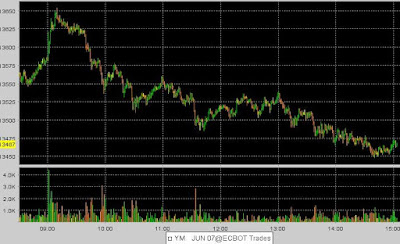
Above find an intraday graph of the Dow Jones Industrial Average for May 24th. As you can see, it spiked sharply that morning at 10am (9am Central Time) when new home sales data came in "better than expected". From Briefing.com,
Economic Perspective: Review of New Home Sales data
New home sales in April took a surprisingly large 16.2% jump to 981,000 annual rate. This follows a modest gain in March. It is hard to conclude from this increase that the problems in the housing market are over, but this will certainly ease concerns about the severity of the problems in the new home market. It is clearly bullish from an economic and stock market standpoint because it lessens the downside risks... The major indices have seen a strong move to the upside on this morning's data, with the Dow pushing higher by ~60 points following the data, the SPX gaining 5 pts, and the Nasdaq gaining 5 points on the release.
I shorted into this spike of the market and quickly made some good money. I shorted because the sales "volume" of new homes (or existing homes) remains a wholly irrelevant metric. All that matters is the PRICE of home sales - at least as far as the larger economy is concerned. Getting aroused over a sales jump would be as silly as celebrating a high volume day in one of your stocks. But nobody really cares if Google traded 2 million shares on a given day or 20 million shares; they care whether or not the stock went up or down.

Home prices are dropping, in fact quite rapidly these past two weeks. I know this from watching the 30 year Treasury bond. No anecdotes from brokers or aggregate national sales data can refute the mathematics of Higher Rates = Lower Home Prices.
First of all, almost nobody knows this. They may sense it but I have never seen or heard the naked math discussed anywhere. So I'll provide that service presently.
On May 8th, the 30 year yielded 4.80%. Two weeks later, as I type this, it's yielding 5.03%. So essentially, rates have risen a quarter point (23 basis points). That lowered the theoretical value of every home in America and I will tell you by exactly how much.
Consider four theoretical homes priced at: 250k, 500k, 750k, and $1 million bucks.
When 30 year fixed mortgage rates are 5.75%,
A 250k house costs $1,459 per month
A 500k house costs $2,918 per month
A 750k house costs $4,377 per month
A $1 million house costs $5,836 per month
(These figures represent total capital costs of homeownership. It doesn't matter how much money you put as down payment on the house because the total cost of lost interest on your down payment and paid interest on your mortgage always adds up to the capital cost of the home's price.)
Now when interest rates rise, obviously a given monthly payment doesn't mortgage as much as before. To find out how much, change the interest rate on a mortgage calculator and then lower the principal amount until the monthly payment equals the level before the rate change.
You'll find out that at 5.75%, a $1,459 payment covers a 250k house, but when rates rise to 6.00%, such a payment only buys a $243,300 house.
Continuing, a 500k house drops in value to $486,700.
A 750k house becomes a $730,200 home.
And a $1 million house depreciates to $973,500.
As the math illustrates, every house in America just lost about 2.65% of its value.
This semi-dated link I found says that American consumers owe $8 trillion in mortgage debt. Since consumers own about half of their homes these days, impute the total value of housing real estate is around $16 trillion.
Therefore, the recent bump in rates shaved roughly $424 billion (2.65%) from the coffers of homeowners.
$424 billion !!!!
Now let's do the math again, only with a theoretical rise in rates from our current 5.75% to 7%, 8%, 10% and then 15%.
Here's how much every house will depreciate for given higher mortgage rates.
-12.28% at 7%
-20.47% at 8%
-33.50% at 10%
-53.80% at 15%
I believe that within three years, we will see 8% mortgage rates. So I am forecasting an approximate 20% decline from today's levels.
Devil's Advocate - But if they have a fixed mortgage, homeowners are safe, right?
NO.
Their payments for that particular house may be locked in at a set rate, but the proceeds from any sale of the property will theoretically be 2.65% lower; also any potential home equity loans would be lower. Remember, the value of your home has nothing to do with what you paid for or put down on the house - it's wholly determined by what OTHERS can currently pay for it.
Say this homeowner lived in a development of identical houses and wanted to move down the street into a facsimile of his current house. He couldn't do it without incurring higher costs. Allow me to illustrate how this fixed rate borrower is still at risk to interest rate pops.
Joe Blow just paid 600k for a house in this mythical neighborhood of identical homes. Every home there is currently worth 600k. Joe Blow puts a 100k deposit down and mortgages the 500k balance.
Suddenly every home is now worth 550k due to an interest rate spike.
Joe decides to sell his house and move down the street into another house that's also now worth 550k.
He sells his original house for 550k, uses $500,000 of it to pay off his mortgage, and used the 50k he has left as a down payment on his "new" house. Obviously Joe needs to borrow 500k more in mortgage debt, ONLY HE HAS TO DO SO AT THE PREVAILING HIGHER RATES NOW - so his payments are higher than they were before.
Joe Blow bought his first house and "locked" into a fixed mortgage. He thought he was safe from the bond market - HE WAS WRONG. Now he has zero equity (instead of 100k) and he has higher payments and an equal debt for the exact same type of house!!!
Many people mistakenly think that once you buy a house, they are insulated from larger market fluctuations but that is only true if rates stay the same.
In America, one cannot take their mortgage with them when they move (in Britain it may be allowed). They need to take out an entirely new loan at market rates. After all, a mortgage is a loan based on a specific house. The specific location, price, timing, and financial status of the borrower were extremely important variables for the lender. The lender doesn't want what they had previously deemed a safe loan transferred to another property, in another town, on a differently priced home, when the financial status of the borrower may or may not have changed.
I want to make a few more points about how important the 30-year bond is to our economy.
When interest rates tick up as they just did, it's not just homes that lose value. All income bearing assets lose some value because they compete with Treasuries and corporate bonds for funds. Everything from gas stations, to hardware stores, to shares of stock, to professional sports franchises lost a couple of percentage points of value over the last few weeks. Cars and college tuitions got more expensive because they rely on financing. Name just about any enterprise or product and it recently got pricier to underwrite and produce.
Now this leads to my second point.
Right now, real estate has consumers in an inflationary vice. Residential rents are rising. Commercial rents are rising - they always do but are on a meteoric rise now. Allow me to explain. Most businesses sign ten year (or longer leases). So when they expire, they'll be reset in an entirely different (higher) real estate market. You may have noticed several of your favorite restaurants or stores suddenly closing. "How could that be...", you wonder, "they do a good business there?" Well, their lease was probably up and the building owner can likely get a whole lot more rent from say a real estate agency, a pharmacy, or a corporate restaurant chain. (Have you noticed how the CVSs, Duane Reades, and Walgreens are taking over everywhere? It's because they make so much money from prescription drugs that they can pay exorbitant rents, that little delicatessens and bakeries can't compete with.) The reason commercial rents are rising so much more than normal is because the economic landscape has grown extraordinarily since 1997 - remember, back then, the internet was just a novelty. We've had the greatest bull markets in both stocks and bonds (real estate) crammed into a mere ten years. Your bakeries, restaurants, and bars will still be around but expect some real expensive shopping there going forward - after all, they have to pay their ballooning rents.
It's easy to see how rising rents (commercial and residential) are inflationary events for consumers, but house prices are dropping, that has to be deflationary, right?
WRONG.
If nobody owned a home, declining house prices would be a very good thing. BUT, about 70% of households in America now own their home. This dropping market is only a deflationary event for first time home buyers like me (though my rent is ticking up slightly).
The housing malaise may be deflationary for plasma televisions, sheet rock, and granite countertops, but it's absolutely inflationary for consumers. This was always just an undeveloped intuition of mine. I figured that home equity was in part a major currency and any depreciation of a currency could be deemed inflationary because it represented a loss of purchasing power. So then, is home equity a currency? Well, Americans re-mortgage their homes to send their kids to college. They use it to buy vacation homes; and they use it for estate planning/life insurance. Etc. It defies all my experience to NOT see homes as veritable ATMs for most Americans.
Recently Taylor sent me an insightful article that had a more illuminating take on the interplay of home ownership and inflation.
Number Three: Home ownership was the American dream only to the extent that housing protected Americans from monetary inflation. Presidential candidates this year will wax ad nauseam that home ownership is the American Dream and that this dream is now too expensive for average Americans. What they won't talk about is how government policies, and specifically monetary policies, help bring this situation about.
What is rarely asked is why home ownership ever became the American Dream. The dream was never so much to own a home for the sake of it. Rather, the real dream has always been to protect wealth from the evils of inflation, and the middle-class housing market generally served that purpose. Housing was the middle class's best hedge against a growing government intent on expanding its scope and power by inflating the money supply.
Today, housing looks like a relatively weaker hedge, and if this trend continues, middle-class wage earners will have to find better assets in which to store the brunt of their wealth.
In other words inflation has been omnipresent for a while, but homeowners have been sharing in it and thus its full bane has been blunted. Now, the declining housing market will unmask the villain for all to see.
Lastly, why am I so bearish on the bond?
Here's part of a comment I left on another blog.
How do I know the bond is toast?
Look at it this way, the housing boom brought homeownership (or home indebtedness) up to 69%. Essentially, it made the whole country long the bond. When the public piles into an asset, a reversal always follows.

So there you have it. Higher long term interest rates are bad for real estate prices, bad for consumers, and inflationary. Oh yeah, they are bad for all debt-laden governments as well.
Long the long bond....it's a very crowded trade. It's something you definitely should diversify away from.
Subscribe to:
Posts (Atom)
