Thursday, July 21, 2005

More Morons


I had a guy tell me, in my own house, that

“I don’t think 9/11 would have happened if Clinton was in office”.

My reply,

“Didn’t they try to blow up the WTC in 1993 when he was in office???? Didn’t they try to blow up the same damn building?”

He is lucky that I don’t put his pic on the blog!!!!

Maybe I need a Bill O’Reilly type doormat that says - The Marginalizing Starts Here. It is hilarious when my wife almost does something that is questionable and I threaten to put her on my blog if she does. Just kidding sweatheart.

Of course she doesn't read my blog because "I LIVE YOUR (bleepin') BLOG".

Why have feminists been reduced to a mere “nuisance”, only being taken seriously at places like Harvard? Well, when consensual sex is considered rape:

“Many feminists would argue that so long as women are powerless relative to men, viewing a ‘yes’ as a sign of true consent is misguided…”

That was uttered by none other than Susan Estrich (frequent guest of fox news, law professor, and former Dukakis campaign chairPERSON.)

Rosie O'Donnell banned her lover from breastfeeding their baby. She wins worst mom of the year, hands down.


In 1999, the Bank of England told the whole world they were going to sell over half of their gold bullion holdings. The advertising was as deft as playing poker with a publicized hand. The gold market dumped and they sold most of it around $273 per ounce. Today gold is over $425 per ounce. Had they held it, they would be $1.5 billion richer. It seems that confiscatory taxes weren't sufficient for the British politicians - they had to plunder the nation's hard assets as well.

CaptiousNut should be noted here too. He sold 40 gold contracts at $260 in 1999. Playing the hindsight game, had I held these for 6 long years, I'd have $660,00 more.

Tim Wirth, while an adviser to President Clinton said,

“We’ve got to ride the global-warming issues. Even if the theory is wrong, we will be doing the right thing in terms of economic and environmental policy.”

More whitewashing. The CBC (Canadian Broadcast Corporation) which is heavily subsized by the Canadian government has decided to not refer to the events of 9/11 as a terrorist attack.

Instead, they prefer "the destruction of the World Trade Center".

Very nice and neighborly.

Yeah, a sign would have saved your son. It is always someone else’s fault, especially in Boston.

When Ruth Bader Ginsburg was up for Supreme Court nomination in 1993, she had a wee bit of egg on her face. In a line of questioning from Senator Orrin Hatch, she asserted that a business would be guilty of racism simply by statistical measures, i.e. not employing minorities equal to the proportion living in its community.

With that, Senator Hatch informed her that in her many years serving on the D.C. Court of Appeals, she had hired 57 employees – none of whom was black!!!! (D.C. is around 90% black)

Apparently, laws are only for the little people.


Last night, I went out to dinner with a guy who was visiting Charlotte on business. When the restaurant bill came, he suggested we don’t leave a tip because,

“we are never going to be back (to this restaurant)....”

Now this guy is college educated and has a management level position at Fortune 500 company. Where does his obvious social and economic ignorance come from? Well he is a lifetime Bostonian. Born, raised, attended college there and never really been anywhere else. I have dined out with countless people all over the country and have yet to witness anything like this guy. I know plenty of cheap tippers and whatnot, but this guy was out with 5 other people that he barely knew (new colleagues) and while otherwise completely normal, polite, civil, professional, etc., he made his suggestion with ease and was totally blind to how others might perceive it. Clearly, he runs in circles where such practice is prevalent. I guess to these people, a tip is not part of the restaurant tab, but rather simply insurance against the staff spitting in your food on the next visit.

Prediction: Once I move to Boston (two weeks hence), I will barely have to open my eyes and ears to fill up this blog with such examples of economic illiteracy.

Sunday, July 17, 2005

Tax Cuts and Dissembling "Economists"


A big headline recently was that federal tax revenues have made a big jump. They have been coming in far above all projections and up are 15% overall from last year.

But no one can report this on the simple level that I just did. The Bush administration wants to attribute part of it to tax cut stimulation and its opponents are digging deep to spin their retort.

The most common spin attempt is simply omission. Just as most media outlets have ignored the positive action in the stock market, they have also turned a blind eye towards this favorable tax news. Of course the media will ignore whatever they want for a variety of reasons. Some may deem positive economic news to be too boring while others may be pushing political agendas, be they socialist, anti-Bush or whatever. Thankfully, the press, for all its ills, is mostly unregulated in this country.

I have heard more than a few times, that every time marginal income taxes were cut, tax revenues have increased dramatically. So my curiosity was piqued and I did some minimal research. Apparently there have been three major instances of marginal tax rate cuts: President Coolidge in the 1920s, followed by President Kennedy in the 1960s and then President Reagan in the 1980s. In all three cases, tax revenues immediately jumped drastically.

Only on a surface level would this seem counterintuitive. After all, how could lowering rates possibly raise revenue if everyone was supposedly going to pay less tax than the year before? The answer is that tax policies are dynamic – meaning that they actually alter the way people behave, work, and invest. The US economy is not a static pie but rather a growing dynamic one. Lower taxes motivate people to work more, invest more, take business risks, realize capital gains, etc. It has worked every time.

I think President Bush’s tax cuts were smaller than other presidents’, and this is certainly a subject of debate for some idling economists. I also think that Bush’s cuts are really just offsetting some of the creeping Alternative Minimum Tax. But this line of thinking is purely speculative and absolutely un-provable.

But I discovered a few interesting things while researching this blog. First, in line with my contention that the media is ignoring the increased tax revenue story, I had a hard time finding a link to a basic news summary of it. I couldn’t believe it.

Next, when I googled “tax cuts increase revenue”, the first non-news link that comes up is this, described as “A liberal essay rebutting the myth that tax cuts increase tax collections. ...”

How is this significant? Well a little lesson about Google search results. Google does rank sites on keyword matches, but also on how many times they are hit and hyperlinked to in other sites. What my search told me was that this link is currently (search results change over time) a prominent and popular destination. Furthermore, this link was followed by several similar essays, all denouncing “supply-side” economics.


I was very surprised, given the recent news of higher tax revenues, that all of these links dominated the search results. It would be like googling Tiger Woods after he won his second major tournament this year and being led to websites declaring that he was in a slump.

But anyway I visited a few of these sites and read a bunch of studies and essays similar to the one hyperlinked above. Many seem quite convincing and authoritative at first, but a mere two minutes of thinking revealed their flaws to me. They all start out with dubious assumptions. From the link above: “assume the economy always grows X percent”, “let’s adjust for inflation”, “assume a normal business cycle of X years”, etc. And then carry on to some pretty complicated, yet convoluted thinking.

What all of these “studies” had in common was they all looked out about 10 years from the time of the cuts. Basically, the salutary short term effects were so obvious they had to widen the sample period to try to prove their theses. But this completely invalidates them, once you look out ten years, you introduce so many more variables that all claims so derived are FUNDAMENTALLY AND CATEGORICALLY FLAWED.

Since the tax cuts of the early 1980s there was a real estate market hiccup, the end of the Cold War, massive increases in federal entitlement spending, demographic shifts, etc. Where does this stop? Is the 2015 recession going to be blamed on Reagan’s tax cuts? It is pretty ridiculous that this passes for academic research.

Much of economic theory seems to have been hijacked by highfalutin propagandists.

Anyone that thinks taxes aren’t anathema to economic growth is living in la-la land. Marginal tax cuts have been associated with short term economic recovery now all four times they have been tried.

I was surprised to learn that the top marginal rate was as high as 70% when Reagan came in to office. Can you imagine getting a $10,000 bonus and only seeing $3,000 of it after taxes? And the rates were even higher between 1936 and 1962.

My wife’s father was in the real estate business and it was almost a rule that whenever he sold one building, he would immediately parlay the proceeds into another. I just assumed that this was a small tax avoidance strategy to avoid capital gains, but now I realize how huge and necessary this tax deferment was, given the exorbitant tax rates of yesteryear. It is called a 1031 Exchange, and they are still extremely popular now with today's hot real estate market, even though top marginal tax rates are half what they once were.

Politicians, and far too many of their constituents, just don’t understand the basic laws of taxation. Consider the Russian oil industry. It accounts for 11% of world output. Now one would think with $60 oil, the Russian oil companies would be swimming in cash and ramping up exploration and development. But they are not. Some companies, such as Sibneft, actually are spending less money on exploration than they were spending with oil $20 per barrel lower, 2 years ago. The culprit is a 89% Russian marginal tax rate. Why dig something up if the government is just going to confiscate it via taxes.

If income tax rates were 100%, nobody would work. So as tax rates drop from 100%, the incentives to earn income rise and thus so does tax revenue. The point of diminishing returns is just frankly not known. Some surmise that it is drastically lower than today’s rate of 35% and I would be inclined to lean this way. I think some of the developing Eastern European countries have instituted much lower flat taxes and so far the evidence is supporting my hypothesis. This I will have to look into.

Tax cuts are great..... If only we could slow goverment spending.

Thursday, July 14, 2005

More Economic Illiteracy and a Hillary Cameo


A few years ago my wife was in need of an air conditioner. Her friend/neighbor informed her that another building tenant was coincidently trying to sell his. So my wife went up to see it. The seller wanted $150, my wife bid $130 (don’t ever say “offered”, the buyer “bids” and the seller “offers”), and the air conditioner changed hands at $130.

My wife went home and communicated the sale to that facilitating friend/neighbor of hers. My wife was quite happy with her procurement and described the very simple bidding process. Well guess what, her friend/neighbor became furious and claimed that it was unfair and deceitful to underbid the offer. She declaimed, “if you could afford $150, then you should have paid $150 !!!!!” Of course , my wife was taken aback by the no longer latent stupidity of now, just her neighbor.

“Pay what you can afford” or “From each according to their ability, to each according to their need” - a central tenet of socialism.

Next exhibit of economic illiteracy and somewhat of a corollary to the forementioned:

As a busy mother of a newborn, my wife found a forum, charlotte mommies, to be quite helpful. She would post questions pertaining to local pediatricians, daycare, teething, etc. and was almost overwhelmed with the enormity of instantaneous and helpful replies she would get. The site was truly a great find.

Of course, sometimes the posters got slightly off-topic. One “mommy” posted a tearful message that she had caught her husband cheating and with two small kids at home, she didn’t know what to do. Well that comment thread exploded right away. It was quite amazing to see the “reply” number jump into the hundreds.

Since we were moving to Boston, my wife sought out and found a similar forum for Boston mothers. Now consider this off-topic post from a Boston “mommy”:

“Does anyone know what the going rate is for maid service? ….I think I am underpaying mine…”

Do you think this woman throws in a few extra bucks when her steak at Outback is particularly tasty? Or pays 50 cents extra at the Mass Pike toll booth because the road is clean? (No way she is smart enough to have EZ-Pass or Fast Lane)?

This “mommy” thinks she is being compassionate by presuming that her maid is so damn stupid as to be unable to discern a fair wage for herself. Boston is not like rural Brazil or anything – despite being the anti-business exemplar; there are plenty of other job opportunities for this UN-exploited maid.

This “mommy” would definitely vote for William Galvin for governor.

Now for today’s last example of economic illiteracy that will certainly “one-up” its predecessors:

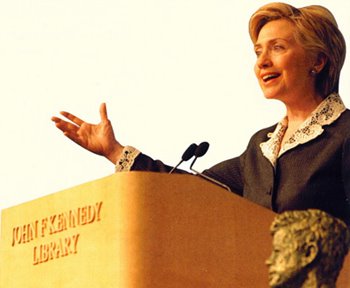
Hillary Clinton speaking to her “choir” in Aspen. From the Weekly Standard,

Hillary wasn't done giving us her mad moments in her Aspen Ideas Festival speech (and don't think Mad wouldn't have a field day with the concept of an Ideas Festival, either). Later in her remarks, she delivered this eye-popping economic analysis for the Colorado audience: "Ours will be the last generation to rely so exclusively on fossil fuels." She added that the "ups and downs of the global oil market cost the U.S. economy $7 trillion last year . . . almost enough to pay off our entire national debt."

Seven trillion dollars? That would surprise most economists, as well as Mad magazine readers who learned both to question authority and check sources, since the entire American GDP for 2004 amounted to $11.735 trillion according to the BEA; $1.5 trillion came from imports of goods. Energy goods (both domestic and imported) only accounted for $250 billion, making it extremely unlikely that price fluctuations in a single import commodity market could have generated anywhere near the kind of economic damage Senator Clinton cited.


Ignore the vapid global warming rhetoric and consider the ridiculous $7 trillion number she threw out there. It wouldn’t be near accurate to call her economically illiterate – I am going to have to search for a new term, maybe on a psychiatric website.

Given the long memory of today's de-monopolized internet media, I can't believe any aspiring politician would utter such nonsense. But I can see why Hillary likes to ban the (free) press from her "choir" fundraisers.

Tuesday, July 12, 2005

William Galvin - Poster Child for Economic Illiteracy


William Galvin is the perfect poster child for economic illiteracy.

He is hellbent on holding up the Gillette/Proctor & Gamble merger. He was just on CNBC today trying to justify his meddling and it would have been laughable if not so infuriating.

Summarizing...

Procter & Gamble and Gillette have agreed to a merger, with near unanimous shareholder approval on both sides. Yet, the politically aspiring Secretary of State William Galvin has made it his personal crusade to interfere with this deal.

Gillette is based in Massachusetts and the dim-witted Galvin claims he is looking out for the best interests of Gillette employees and stockholders. First of all, there is no audience for this tired rhetoric denouncing any and all forms of layoffs, even the imaginary ones yet to take place. What these fossilized politicians need to realize is that it is 2005, not 1932. The economy is more dynamic, as is the labor force. People today will have on average seven jobs in their careers.

Never mind that layoffs are the essence of a flexible and innovative economy. Galvin needs to go look at the French and German economies to see what overly protective job legislation does to an economy. Furthermore, the buyouts and unemployment benefits in Massachusetts are so generous they approximate hitting a scratch ticket. (I have detailed this in a previous blog on the Fleet merger.)

But this layoff talk is just a ruse, Galvin is not protecting the “little people” as he purports. He is hiding behind them or more accurately exploiting them to springboard clichéd business bashing and his own political aspirations.

The CNBC crew really shredded him today. Paraphrasing:

Galvin: “Procter and Gamble is just going to cut and run (Gillette)….”
Becky Quick: “But isn’t Warren Buffet for the merger? He has never been a cut-and-run guy….”
Galvin: “Well, he is conflicted…”
Becky Quick: “Yeah, but he is the largest shareholder of Gillette and very excited about the merger…”

Apparently Galvin knows better than Buffet what he should do with HIS Gillette shares !!

CNBC Guest: “If I have a house and want to sell it for $2 million, are you going to step in and say, no – that house is worth $2.3 million, you have to sell it for that?”
Galvin: “In that case I would look out for the seller..."
CNBC Guest: “BUT I AM THE SELLER !!!!!”
Galvin: “eerrr…..ahhhh….. (stammering)”

David Faber: “Why are you blocking this deal when all the shareholders want it?”
Galvin: “Because the price is too low for Gillette….”
David Faber: “No offense, but you aren’t an analyst, you are a politician. How do you know what Gillette is worth?”
Galvin: “We have done an independent study that shows Gillette is worth $22 billion more. Gillette is selling out too cheap…”

This is it; Galvin’s last statement gets him automatic induction into the Economic Illiteracy Hall of Shame.

At the time of the initial merger announcement, investors from all over the world were valuing Gillette at $45 billion. Proctor & Gamble will end up paying $57 billion for the company. Yet Thomas Galvin alone has the perspicacity to see the true value of Gillette at $79 billion. There is a multiple choice of modifiers to describe such thinking: intellectual arrogance, bullshit, sophistry, ..etc.

About Galvin’s statement, “…selling out too cheap…”

David Faber: “But they are not selling out. Gillette is getting .975 shares of P&G. Won’t Gillette shareholders participate in the continued growth of P&G?”
Galvin: “….errr…ahhh….too cheap….selling out….$22 billion….the reputation of my office…blah….blah….(continued stammering).”

Let me illustrate the kink in Galvin’s $22 billion argument.

Consider that maybe P&G is “undervalued” as well. If undervalued by more than $23 billion, then maybe Gillette is being overpaid. Hey Galvin, did you do an “independent” valuation of Proctor & Gamble? See, one could throw the fanciful valuation game right back in your face, IDIOT.

The only little guy Thomas Galvin is looking out for is himself. He is an Eliot Spitzer wannabe. That pic above is from his own site and pretty much encapsulates all there is to know about him and his "conflicted" ambitions.

Unfortunately, Galvin’s economic illiteracy is representative of way too much of Massachusetts. A virulent anti-business climate and graying population don’t bode well for the state’s future. I can’t believe I have to move back there.

Buy Small, Sell Big


It is getting zero news coverage (MSM bias of omission?), but last week small and midcap stock indices reached all-time highs. Yes, you heard me right. While most investors are weighed down by the stocks of the last bull run, the Russell 2000 and S&P Mid-Cap indices are percolating.

Why are those large cap funds and indices not participating? The answer is simple math. A huge portion of these stocks are represented by Cisco, Oracle, Intel, Sun Microsystems, IBM, General Electric, Microsoft, etc. Those stocks are all trading near 1999 levels.

Here is a little investment math. If a mutual fund manager had a big stake in say Microsoft in the early 1990s, as that stock exploded, his fund would of course benefit. But since Microsoft was appreciating so much, its percentage of the mutual fund’s total investment would keep rising. (Microsoft has appreciated to 144 times its IPO price.)


Invariably that fund manager would have to pare back his MSFT shares. Mutual funds, by law must adhere to their prospectuses which limit individual stock exposure to a certain percentage. So while MSFT, EBAY, CSCO, etc. were doubling every six months or so, these fund managers were forced to sell their best performing stocks. How much sense does that make?

The S&P 500 index benefited from the other side of this math. As Dell, GE, SUNW, etc. appreciated, their index weights grew as well. So index funds were not forced to sell their best performers and in fact benefited disproportionately. These are the intrinsic workings of a market-capitalization weighted index and they wholly explain the underperformance of mutual funds during the last bull market.

Recently, the additions to the S&P 500 have not zoomed into positions of market leadership, a la 1997-2000. So what we have is top heavy index funds and a bunch of sheep mutual fund managers who are afraid to diverge too far from the index averages.

So the large cap averages probably won’t do much until we have a bunch of new companies displace these slow growth stocks of yesteryear. Right now it looks like Google is the only prospect and that won’t be enough.

Google update: Google Search is still gaining share at the expense of MSN Search and Yahoo. I think it will soon have an unassailable market position similar to EBAY.


I may be the polar opposite of a blue-collar homeowner, yet Home Depot has got to be my favorite store to peruse.

Without looking, how do you think Home Depot’s stock has fared in this housing boom?

It may be surprising to many, but in the last 7 years, with home prices up nearly 150% and 3% home equity loans selling like hotcakes – Home Depot’s stock is unchanged over this period. Investors have fared much better owning shares of Lowe’s (up 400%). This example really highlights the wisdom of buying small growing companies over large stagnant ones.

Whitewashing Update - Et Tu BBC?

The BBC shuns the word "terrorist" to avoid "value judgements".

Isn't this what Karl Rove theorized?

Monday, July 11, 2005

Whitewashing Charlotte Fireworks


Any news junkie knows the regular gripes against Big Media. One such issue just won’t go away – that is the insistence of whitewashing terms. Journalists prefer militant, insurgent, and suicide bomber over “terrorist” and will seemingly go to any length to avoid the term.

Bill O’Reilly was recently complaining about the New York Times reference to Abu Musab al-Zarqawi as a “Jordanian Fighter” instead of as a terrorist or serial killer. The Times responded that their audience is sophisticated and needn’t be reminded that al-Zarqawi is a terrorist on a constant basis. While that is partially true, in the larger context of Times news reporting it seems to many to be a whitewashing. Anyway, the Times is free to write whatever it wants and readers are free to read other papers. While it may be bad business to alienate potential readers with such trivialities – bad business decisions remain a protected right as well.

The brouhaha in Charlotte last week was over an “incident” at the 4th of July fireworks show.

Apparently 2,000 people rioted after the fireworks, but the Charlotte Observer was insistent that it was only a “melee”.

Charlotte leaders and police officials promise that next year's uptown fireworks
show will go on despite a melee involving 2,000 people after Monday's event.

The commotion led to one gunshot wound, 20 arrests and a police
crackdown that brought in more than 100 extra officers.

Charlotte-Mecklenburg police estimated that crowds numbering 2,000 had started to grow unruly near Trade and Tryon streets after the fireworks show ended about 10:20 p.m. Monday. The masses swarmed up to Eighth Street and down to the transit center in the muggy heat.

Tensions escalated as people threw fireworks into the crowds, blocked traffic and refused to respond to police, said Capt. Tim Jayne. They pushed a Dumpster into the street, he said,
and intimidated people trying to leave parking garages. By 11:10 p.m. police mobilized extra units, sending an urgent call across police radios requesting all available officers to come uptown from across Mecklenburg County. Police activated a civil emergency unit of about 15 officers trained to control crowds. Animal control officers were recruited to guard Tryon Street amid dozens of police and sheriff deputies' cars lining the blocked roads.

Gunshots rang out, with one person shot in the hand. Sgt. Jim Hollingsworth said he saw
people throw lit firecrackers at police. Police called in vans to cart people away and made requests for plastic flex-cuffs to detain them. Police locked down streets block by block, pushing the crowds out of the center city.

It wasn't until a few minutes after 1 a.m. that Jayne started to send officers back to
their districts, but many remained on the streets directing traffic.

They said they had 15 officers working in uptown -- more than scheduled for a regular night -- plus another 39 working off-duty to provide security and guard street barricades at the SkyShow. They had to call in about 100 more to handle the disturbance, Adkins said.


Does this sound like a “melee”?

This is why these newspapers are total pieces of excrement. They are more concerned with how sensitively events are characterized than with what actually happens. My advice to everyone – stop reading newspapers…..your IQ will only go up.

Furthermore, stay away from "free" events. This stuff went on in Philadelphia when I lived there as well.

I figured while on the whitewashing topic I would throw a 9/11 pic up. When was the last time such an image was on network television? This stuff should be plastered everywhere, in my opinion.

Saturday, July 09, 2005

Google Maps

I just downloaded a program called google earth. It lets you use satellite imagery to see any place on earth. You can then highlight points of interest, be they golf courses, malls, etc. Of course it is free. A decent broadband connection and relatively new computer is recommended. Sorry no Macs. Here is the link to the site. Below is a shot of Lower Manhattan. Note the WTC site at the top.


The site is more robust than this. It is streaming so you can zoom in and out and move in any direction. Also the resolution isn't done justice by this small screenshot. So much for privacy, but definitely download it.

Thursday, July 07, 2005

Moron Roundup


Someone complained to me that the name of my blog, "Marginalizing Morons" was arrogant.

In the spirit of a previous blog, they should consider the ridiculous alternative, "Elevating Morons".

Here are the results of a recent Moron Roundup.

Teachers now avoid red ink because it is too stressful and demoralizes students. Purple is apparently much more sensitive.

Legislators don't want cops chasing criminals in California. The proposed law actually would make cops personally liable for anything that happens during a car chase. Look at this nugget from State Senator Sam Aanestad,

"Probably the worst way to catch someone is by chasing them."

Sarbanes-Oxley legislation is making companies go private and scaring away foreign companies from listing in the US.

Salton, maker of the George Foreman grill is on the verge of bankruptcy. This is truly amazing considering that they sold over 70 million grills. George has made around $150 million from it though. (also making the Moron list is anyone who claims that the grill is "easy to clean".)

Stephen King – at the University of Maine commencement, urged graduates,

...to "give away a dime of every dollar you make," arguing, to applause, that "if everybody did it, maybe we could make Mr. Bush let go of the weapons he loves so well and give back some of the money that he spends on them to the farmers, the unwed mothers and the working poor.

Last I checked I give away 40% of everything I make via confiscatory taxes – it surely would be a different world if lowered to 10%.

The logical gaps between giving away money and “Mr. Bush’s weapons" are only outdone by the socialist talking points. Yeah, let’s be more like foundering Europe. What a shock, another rich celebrity and beneficiary of capitalism wants to uproot the system that made him.

Meet Coco Crisp[sic] of the Cleveland Indians. Yes, as in the cereal. Pretty much if your last name is Crisp, there are only two names your parents should avoid, “Burnt-to-a” and “Coco”.


The Chinese think they can bolster their stock market by limiting new issues. From Briefing.com

According to the WSJ, Chinese regulators are trying to support sagging share prices on the country's two domestic exchanges, by restricting access to them. The move risks marginalizing China's stock mkts even more, as a slew of Chinese co's head overseas to raise capital, say securities analysts. With the benchmark Shanghai Composite Index near 8-year lows, the China Securities Regulatory Commission has quietly imposed a fresh moratorium on new share issues that will likely last through Y05, say senior exchange officials. The move follows an earlier freeze on new share issues in the 2H Y04. The latest freeze coincides with a reform program begun in April to unload billions of dollars of existing but currently untradable state-held equity in the Chinese stock mkts. The worry is that the domestic mkts can't absorb so many shares; the two Chinese exchange officials say it is better first to fix the bigger problem of finding buyers for the state-owned stock, which has a total value of about $250 bln. These state shares, which aren't considered new issues, aren't covered by the moratorium."We have to let the current reform play out," says the Shanghai exchange official. "There's no timetable" for resuming new stock issues, he adds.

This economic illiteracy is redolent of the French limiting the work week to 35 hours. They thought that there was a finite amount of work and that by reducing the hours of “overworkers”, they would eliminate unemployment. Could they be any more bleepin' retarded?

Researchers have found that male circumcision reduces the risk of contracting HIV by 70%. Why does this make the Roundup? Because the world is spending billions of dollars to find an HIV vaccine whose targeted risk reduction level is only 30%. When are people going to realize that scientists are mostly a government subsidized welfare demographic?

Furthermore about male circumcision, when my son was born the doctor asked if we wanted the procedure. They gave us all sorts of pamphlets and information about circumcision. One such item said that many people opt for circumcision for "...religious, cultural, and social reasons." We requested the procedure and told the doctor that it was for "social" reasons, i.e. we didn't want our son excluded from the foreskin-free cliques at school.

Also, in a country where male prison inmates in California can get sex change operations and breast reduction surgery paid for by the state, circumcision for baby boys is not covered by major HMOs.

This great headline yesterday, "CBS to Join the Storytelling Business..." I guess after the Dan Rather fake documents fiasco, why not make it official.

Morgan Reynolds, a former economist for the Department of Labor, thinks that the government secretly imploded the World Trade Center on 9/11. Shouldn't he be institutionalized?

Steven Spielberg is lamenting the dearth of recent UFO sightings. Let's give him a break, he may just be totally immersed in his work.

And lastly this beauty from the global warming whackos:

Global warming looks set to be much worse than previously forecast, according to new research. Ironically, the crucial evidence is how little warming there has been so far.

When are these nutjobs going to realize that trying to study larger weather trends with less than a 50 year sample period is like trying to predict the winner of a baseball game from witnessing a single pitch?

Friday, July 01, 2005

Government Schools versus Home-Schooling


In the northeast, there is a plethora of private schools that I guess I assumed was the norm everywhere else. When I moved to Charlotte I realized that this is simply not the case. There is only one Catholic high school in the whole area and not much in the way of other private schools.

Charlotte has seen a huge increase in population over the last 10 years and the public education system has been unable to manage the growth. Overcrowding, discipline problems, and something ridiculous like 20% annual turnover of teachers. The Charlotte-Mecklenberg school system is basically a disaster and with the dearth of private schools, parents have turned to home-schooling en masse.

Home-schooling seemed non-existent up north, but that is due to better schools, more private schools, and a higher cost of living that almost mandates dual income households.

Here is an informative essay that addresses the history of public education, its shortcomings, and the home-schooling option.

The whole idea that government should educate children is a concept that I guess most people take for granted.

Thursday, June 30, 2005

Moron of the Day


Chicago just raised its sale tax to 9%, highest in the country.

Listen to this Moron:

"It will have a negligible effect on mom-and-pop businesses, but the big-box stores who deal in volume or large purchases could be negatively affected," said Alderman Brian Doherty, whose ward on Chicago's northwest edge borders many suburbs with lower sales tax rates.
It is tough to sympathize with Chicagoans when they are the ones who elect such patently ignorant politicians such as Alderman Brian Doherty.

How an increased sales tax will hurt big retailers more than the already uncompetitive "mom-and-pops" isn't even a mystery - it is a falsehood.

Politicians should just say that they are raising the sales tax because they need the revenue?

I have attacked this supposed protector of "mom-and-pops" ruse in a previous blog on Walmart.

No Wal-Mart bash is complete without the requisite empathy for the poor “mom and pop” stores that Wal-Mart devours. This canard fulfills the econo-moronic template as the “pitiable victims of rich evil CEOs”. Every time I hear the “mom and pop” lament, I think back to the last air conditioner I bought in Brooklyn. I went out of town to Wal-Mart and got a huge 12,000 btu air conditioner for around $240. The same air conditioner sold at the “mom and pop” hardware store in my neighborhood for $700. Wal-Mart critics don't care about the moms and pops that shop.


It is basic math, if the sales tax goes up 1% on those air conditioners, the Walmart one will rise $2.40 and the "mom-and-pop" one will rise $7.00.

With electorates and politicans this economically ignorant, it is not surprising that large cities are on the expressway to bankruptcy.

China, Thin Ice, and the Lessons from Japan


$60 oil……

I love it. When oil hit $40 a barrel everyone said it would cripple the economy and now we are 50% higher. But as soon the economy gets hit, whether it is later this year or two years hence, those same broken-clock pundits will be bellowing, “I told you so!!!!”

There is an almost nationwide consensus that oil is “too high”. But sitting around arguing with free market prices is pure intellectual arrogance. The fact is that nobody on this planet KNOWS where prices (stock, bond, real estate, and commodities) are going or what is causing them to move or what level of prices our economy can withstand. Yet this doesn’t stop talking heads from surmising, projecting, or blaming.

$40 oil is too high. $60 oil is too high. China is causing oil to spike. SUVs are the cause.

There is no oil left in Saudi Arabia. Oil companies are lying about their reserves.

Fears of terrorism is pushing oil up (they don’t say this anymore).

The war in Iraq is driving oil up. Alan Greenspan is inflating oil from his interest rate policies.


So much noisy opinion and so little fact.

If a family of four has one box of cookies in the house and it gets consumed, then maybe someone could analyze individual demand components. But oil is a global, highly politicized commodity that is consumed in multitudinous ways all subject to their own sets of dynamic variables.

It is just way too multivariate to study.

About China…

It is estimated that 25% of Chinese banks loans are non-performing i.e. bad.

Remember how Japan was going to eviscerate our economy back in the late 1980s? They work harder, save more money, have superior office desk configurations…..etc. We had to suffer through the semi-apocalyptic Rising Sun by Michael Crighton. What happened?


Well there was no integrity to their financial system – in fact there still isn’t. Japanese corporations prop up failing businesses with the profitable ones and banks won’t pull lines of credit for defaulters. Their system is just too rigid and anti-Darwinian. The result is a steady 15 year decline in Japanese real estate and its stock market.

I am not predicting the same for China, but I predict a definite hiccup in their economy. (At which time I am going to dump some money in Jim Roger’s commodity fund.)

Chinese stocks are tumbling and real estate has cooled off. Remember this is communist country and the transition to capitalism won't be smooth.

We will see if their economy can prove more resilient, flexible, and dynamic when the going gets tough. It is one thing to be hard working and have low labor costs, but if not backed by a solid banking sector....

Tuesday, June 28, 2005

Eminent Domain - A Loophole for the Taxers


In the Kelo decision last week, the Supreme Court ruled that government could expand the definition of “public use” and more easily claim properties in eminent domain cases.

Forget the boring legal and constitutional ramifications, let’s examine the economics.

Don’t let anyone tell you otherwise, but today eminent domain is all about that nexus between politics and economics – TAXES.

Why would local or state legislatures stomp all over property rights? On its face, such action would seem to be political dynamite, but the pols see potential budgetary cuts as the far worse political risk to bear.

Whether it is sports arenas, “big box” retailers, luxury condos, or other commercial development, local politicians view economic development as a vehicle to higher tax revenue and less political heat come budget time. To many, it is not a tough sell to argue that eminent domain grabs serve the greater good at the expense of a few property owners.

Of course the critics clamor about the constitutional rights of private property and invoke the “slippery slope” warning. What will stop local governments from expanding eminent domain to condemn just plain old ugly homes? Or low taxpaying businesses on main streets?

For one thing, I hate slippery slope arguments. Censorship-phobes use it to decry any standards for television content, even on channels that broadcast over government granted spectrum. Here in Charlotte, slippery slope is being used to thwart the bar/restaurant smoking ban. Prominent radio personality Jason Lewis warns, “What’s next? Kicking out beer drinkers…..” I love Jason, but that is ridiculous.

I am not categorically dismissing all “slippery slope” arguments, I just think that they are too oft abused and are lazy scare tactics that muddle or even ignore important contextual issues. For instance, in Jason’s opinion, it should be up to individual bar owners to determine whether or not smoking is permitted. Consumers via their free market choices would then determine what restaurants should do. Heck, I am as big a free market advocate as Jason Lewis, but this just isn’t consistent with existing laws and regulations.

Lewis’s argument ignores the fact that bars are already extremely regulated. They can’t serve minors, stay open all night, can’t have rats in the kitchen, and most onerous of all, they need a liquor license. In some places, such as Boston, licenses are extremely expensive, hard to get, and such barriers to entry preclude any claims of a free market in the bar/restaurant business.

I was at a bar downtown recently when a couple of other customers lit up cigarettes near me. Fortunately the bar was empty and I just moved away from the smoke. But the pregnant bartender had no such recourse. She was hanging at the end of the bar, as far away as she could possibly get. So while there are laws granting disability and maternity leave (10 weeks paid) for other pregnant workers, in Charlotte pregnant bartenders have to work in a smoke filled environment. Allowing smoking in bars is just inconsistent with other laws already on the books. Ultra free-marketers would be wise to inveigh against other more prohibitive regulations.

I am no fan of the Kelo decision, but I think that many people don’t realize how limited private property rights already are. In some tony Long Island towns you can’t get an above-ground pool or even hang your wash outside on a clothesline. I believe some towns limit Christmas light displays, all in the name of road safety (seriously). What about property taxes? If you truly owned the land, why must you pay ever escalating (they will get worse) property taxes?

I know a guy who finished his basement in a New Jersey development. Someone must have noticed through that small cellar window and he was reported for breaking a local ordinance. Property owners often need permits to cut trees down or build fences above a certain height. People that buy homes in historic districts of New York City have to get all remodeling plans approved by the Landmarks Commission. And forget about making a new window or altering the exterior.

Real private property is a nice CONCEPT, but in reality that is all it is.

As I alluded to previously, government agencies are like octopi and no where is this more accurate than in describing taxing authorities.

Taxers (federal, state, and local agencies) are in a constant battle with free market capitalism. They throw a tax out there and taxpayers adjust by buying less, moving, innovating, or any other means possible.

Economically illiterate and lazy politicians feel they have to constantly find ways to generate tax revenue because God forbid they had to cut spending or seek out more efficient government. Here in Charlotte they have several ambitious projects: a new arena, commuter rail, huge interstate highway proposal, NASCAR Hall of Fame, etc. When the issue of cost comes up, the immediate response is “we’ll tax rental cars and hotels….”

I just rented a car in Boston and was hit with at 20% rental tax (25% total including sales tax). It was almost $400 to rent a car for 5 days. I will never do that again, and I am sure that only the dumb, desperate, or very rich would rent a car up there more than once.

The same goes for hotels. Here in Charlotte, big companies have all sorts of corporate housing arrangements that circumvent these taxes. So politicians constantly have to come up with new taxing schemes.

The latest new scheme in North Carolina is to tax “SUVs” just as they recently tried unsuccessfully in Connecticut. It is all about semi-socialist lawmakers trying to use the wedge of class warfare to create a new source of tax revenue. They meekly argue that SUVs are heavier and cause more wear and tear on the roads - but what they fail to address is that SUVs already pay tons more in gasoline taxes, which accrue on a per gallon basis and thus fall mostly on "gas guzzlers". Based on fuel efficiency, Toyota Camry owners pay half the gasoline taxes of Ford Explorer owners and one third that of Hummer owners. But heck, if politicians can get SUV owners to pay more.....that is one less after-school program they have to cut.

Why do politicians try to tax car rentals, hotels, SUVs, tobacco ????

The simple answer is because THEY CAN.

Not many local constituencies are fearful of the aforementioned taxes. To the public, they are a tax on outsiders, a veritable white knight to politicians.

Why are cigarettes so heavily taxed? Politicians will say that smoking related healthcare costs are a burden on state Medicare and Medicaid budgets. But instead of drastically reducing the healthcare options available to smokers, politicians elect to tax current smokers. Tobacco tax revenues go into the general coffers of the states and may or may not find their way to helping Medicare and Medicaid – that is if they don’t get usurped by mismanaged public schools or a football stadium. This is a revenue grab, pure and simple. If golf became politically incorrect tomorrow, they’d start taxing tee times, drivers, hot dogs at the halfway house, and if possible they would tax curse words uttered after bad shots.


The Kelo ruling is a definite short term victory for the Taxers. It will embolden politicians to forge ahead with aggressive tax boosting developments. But what good are stadiums and convention centers if nobody wants to live in those high tax locales? And how good of a contrary indicator will this be that in 2005, politicians were given the green light on real estate investment? Time for everyone else to sell? It smacks of the Clinton Administration suggesting that some of the Social Security "trust fund" be invested in the stock market - in 1999. That was some great timing as well.

Who knows, it may turn out that this ruling becomes a great catalyst for change on the Supreme Court. Kelo can always be reversed.

But in the interim, I see no doomsday scenario here. Taxers have proven no match for free market capitalism.

Just take a step back and look what is going on. Bostonians drive to New Hampshire to buy lower taxed liquor, businesses move just outside of the Philadelphia line to avoid the city-wage tax, budding retirees buy their investment/retirement homes in Nevada and Florida where they'll enjoy no state income taxes, and naïve young people pile on deductible mortgage debt.

Many cities and towns are technically already bankrupt from public pension liabilities so taxes will only go up. Read this from anti-Businessweek. I haven't fisked it yet so Caveat Reader.

Here is my nominee for the Supreme Court opening.

Friday, June 24, 2005

The Hillary Homerun


I am a very experienced trader. “Experienced” means that I have lost tons of money in a multitude of ways, and have had to dig out of some massive deficits throughout my career. What invariably goes through traders’ minds in rough patches is essentially a homerun dream.

If only my biggest long gets a takeover bid….

If only India fires a nuke at Pakistan (when I was long gold)….

If only IBM misses their earnings this quarter (when I was a bleeding short)…..

You can bet that many a ravaged trader goes to bed dreaming of whatever scenario or event could pull them out of their hole in a flash.

So while I watch today’s obsession with “Hillary in ‘08”, I can’t help but see the parallel. Hillary winning the White House is the homerun dream for more than a few people. ESPECIALLY, when this speculation was running rampant BEFORE Bush even started his second term. Four years is a long ass time…..

(For the record, I predict George Allen will be the Republican nominee. But I don’t go to bed dreaming of it.)

In 1992, Bill Clinton came out of nowhere to win the Democratic nomination. Most likely, someone other than Hillary will be the nominee. Probably at no time in history has someone been the frontrunner for four years.

Furthermore, the Hillary homerun won’t solve the dreamers’ problems entirely. Republicans are gaining at every level of government. What good would Hillary be, other than psychologically comforting, if she is facing big Republican majorities in the legislature?

But I differ from most people I guess, in that I just don’t think who the President is really matters much.

On a related note, I played golf with a guy recently who said he ran into Bill Clinton at Hilton Head (or maybe Kiawah – I can’t remember). He told me that Bill was like a dog in heat, trying to pick up his friend’s wife!!!!!!!!

I am not a big fan of Hillary, but I will take her seven days a week over John Kerry – even though she is a cuckold.

Saturday, June 18, 2005

Obese Budgets

.

There are some immutable laws of nature. For instance, a psychiatrist will never tell a patient that they are problem free, an exterminator will never tell a customer that the vermin is completely gone, and researchers will never conclude that they need less research funding.

Inertia is word often used to describe government agencies because once born, it seems they never go away. In fact they invariably grow like amoebas or octopi, stretching their agendas, purviews, and budgets to billowing heights.

Consider the Centers for Disease Control & Prevention, or the CDC. Read about how this $7 billion agency completely botched a report on obesity.

In a report published in March 2004, four of CDC's scholars stated that 400,000 people a year in the U.S. were dying early as a result of obesity and that obesity might soon pass smoking as the country's leading cause of preventable death.

One of the four scholars was CDC boss Julie Gerberding (pictured above), who had earlier compared the obesity epidemic in America with the plagues of the Middle Ages. Announcing the new findings, she said, "Our worst fears were confirmed."

Come April 2005 a research report offered a quite different perspective on obesity. This time the researchers were led by a CDC epidemiologist named Katherine M. Flegal. Their report estimated obesity-driven deaths at 112,000, and added that moderately overweight people gain some protection from the extra poundage, so that net deaths from overweight were in the neighborhood of 26,000. The new finding transformed obesity from fearsome killer to pitiable also-ran, ranking in seventh place on the CDC's list of preventable death causes. It came in just behind gun-related incidents.


As Forbes says, so much for comparing obesity to “Black Death”. Make no mistake, the CDC might be embarrassed, but they are definitely pissed. Just think of all the new funding they “missed” from this lost epidemic. I wonder what it like to sit around and root for epidemics.

Generally speaking, public sector research, polls, and intellectuals are not to be trusted. Their biases are pronounced and only allegiant to their own self-interests.

As I have stated in a previous blog, I really have no opinions on “obesity”. I just find it curious that while life expectancies keep rising, big media (MSM) and academics would have everyone believe the opposite.

(Lest anyone forget, those academics subsist mostly on the taxpayer funded tuitions and research grant money - a welfare demographic in and of themselves.)

The Housing Bubble - A Short Memory Refresher

.

It astounds me that many of today's home buyers don't remember the stock market tumble of only five years ago.

.

In my previous blog, I threw out a hypothetical example where a $600,000 house would did not appreciate for 30 years. Think that is ridiculous? Well consider this:

At the local or regional level, there's a history of ups and downs in the real-estate market. The downturn in the oil industry in the 1980s affected real-estate values in many Southwest metropolitan areas, with home prices in Dallas and Houston dropping in 1986 and recovering three years later. In the wake of the 1987 stock-market crash and the subsequent layoffs in the financial-services sector, prices in Manhattan took a beating. In 1982, a buyer could have paid $237,000 for a Manhattan apartment and sold it in 1988 for $660,000, a 178% gain. But if a buyer bought the same apartment that year, by 1995 it would have fetched just $397,000. It wouldn't reach its previous high price until 1999, according to a study by Corcoran Group, a New York real-estate firm.

The lesson here is that from 1988 to 1999, that Manhattan apartment did not appreciate. So one doesn’t have to go back that far to find a protracted real estate slump. It also bears noting that the late 90s saw the beginning of the greatest stock and bond bull markets in history and that is what pulled up real estate from its malaise. I wouldn’t hold my breath waiting for another such boom. And I wouldn't be surprised if the next real estate bust is worse, given the risky leverage of today's adjustable rate borrowers.

.

Wednesday, June 15, 2005

Real Estate Hot Potato...Buy versus Rent & Invest

.

I just rented the first floor of a two unit building in Newton, Massachusetts. The building just sold two weeks ago and so I could see all of the property specs.

The top unit rents for $1,700 a month and I rented the lower one for $2,300 a month. The building sold for $1 million. Best case scenario – the new landlord will be getting $4,000 per month, or $48,000 per year in gross rent. So 48k on $1 million represents a gross 4.8% yield.

The local property taxes are $7,500 and $2,000 is listed as the insurance premium (I have not checked how realistic that number is.) So now, the net annual rent is down to $38,500 for a yield of 3.85%, already below the ten year Treasury note yield of 4.1%.

From that $38,500 one still has to deduct general maintenance costs, lawn care, water bill, legal/accounting costs, etc.

Also the new owner is losing rent on our unit for both June and July (We start August 1st) – a not so slight $4,600.

Since they never go down, taxes will probably go up. The landlord can’t realistically count on 100% occupancy and rent collection for the life of the building. Tenants may break their lease or he may have a few months between successive tenants. Pipes may burst. The roof may leak. An exterminator may have to be called. Plumbers will extort money from this landlord too. Real estate management is not a sit-and-collect sinecure.

Any way you shake it, the new owner is getting a paltry yield (around 3.7%) on this “investment”. Good luck to him.

My unit represents 57.5% of the rent but I will round up to at least 60% since the upstairs unit is not renovated or as real estate types say, “updated”.

So compare me buying this $600,000 unit versus renting it for $2,300 a month.

If I put $100,000 down, a 5.75% fixed rate mortgage would make my payments around $2,900 a month. After subtracting the federal mortgage tax deduction and adding back in property taxes, insurance, and maintenance, at best my total payment would reduce by $100 a month. By at best, I mean assuming the highest federal income tax rate for myself, flat property taxes, and minimal expenses. So compare the “at best” figure of $2,800 per month to my rent of $2,300. So after one year, I will have $6,000 more in the bank by renting, but if I bought, I would own a little more than that in home equity.

In fact, if I save $6,000 a year for 30 years (the life of the mortgage comparison) and compound it at 4% (today’s ten year rate), I will end up with…

$349,221

To that you have to add the original $100,000 deposit that I did not put up and compound that over 30 years at 4%.

=100,000*(1.04)^30 = $324,340

So adding my annual payment savings (compounded) to the future value of the 100k deposit that I did not have to give up ….

$349,221 + $324,340 = $673,561.

Conclusion, in this very limited example, after 30 years, the renter would have about $674,000 in cash, and the buyer would own the $600,000 apartment. (and lest anyone forget, the homeowner would lose around $30,000 in real estate commissions if he wanted to move.)

NOW HOLD ON. I know that right now, thousands of my blog readers are saying I am an idiot if I think that apartment will be still be worth 600k in 30 years. I am not saying that at all. This is a very sensitive multivariate exercise and I will tweak the variables one at a time.

CaptiousNut will now PROVE that renting is a no-brainer.

First of all, the above comparison has extremely favorable assumptions for the homebuyer and RENTING STILL WINS.

FAVORABLE ASSUMPTION #1:

Local property taxes stay the same. It has never happened and never will.

FAVORABLE ASSUMPTION #2:

The buyer is in and will stay in the highest federal income tax bracket. The IRS lets homeowners deduct mortgage interest payments from their gross income. The dollar savings to the borrower are then:

Dollar savings = annual mortgage interest paid * marginal federal tax rate

For example, the total interest paid in Year 1 of the example is $28,582. If the borrower in is the 35% federal tax bracket, he will be effectively entitled to an $834 monthly rebate. But if the borrower is in the 30% bracket, the monthly tax savings is only $715.

( computational note: 834=28,582*.35 / 12 )

I was amazed at how much marginal tax rates affected the Rent versus Buy equations. That $119 monthly difference between borrowers of different tax brackets becomes huge over time. It is actually one of the few tax laws that favor high income earners.

Remember to compare the $2,900 per month mortgage payment to the $2,300 monthly rental payment, I had to subtract from $2,900 the mortgage interest benefit and then add back in the costs (property taxes, maintenance, etc). Doing so, with a $119 lower monthly mortgage deduction benefit will widen the cost gap between the $2,300 and adjusted mortgage payment. Let’s be conservative again and round $119 to $100. So that brings the adjusted mortgage payment back to its original $2,900 per month.

It also means that instead of the renter saving $500 per month over the buyer, he now saves $600 or a total of $7,200 for the entire year. Let’s replace the $6,000 annual savings figure above with $7,200 and see how much it will compound to over 30 years at 4%.

= $419,065

That is $70k more. Add that to $324k from the compounded deposit and the renter’s total cash after thirty years jumps to $744,000 compared the homeowner’s 600k house.

FAVORABLE ASSUMPTION #3:

Most people don’t realize that the mortgage interest deduction fades over time. In fact, it is straight downhill after the first year. Look below to see how in this example, the annual mortgage interest paid decreases. The second and third columns show the decreasing monthly tax deductions for the 30% and 35% tax brackets (that is total interest multiplied by the tax rate and divided by 12). Remember this is a 30 year fixed mortgage on $500,000 at 5.75 %.

Total Interest Paid ....... 30%............ 35%

Year 1........$28,582.24........$714.56........$833.65
Year 2........$28,202.49........$705.06........$822.57
Year 3........$27,800.32........$695.01........$810.84
Year 4........$27,374.40........$684.36........$798.42
Year 5........$26,923.34........$673.08........$785.26
Year 6........$26,445.65........$661.14........$771.33
Year 7........$25,939.75........$648.49........$756.58
Year 8........$25,403.99........$635.10........$740.95
Year 9........$24,836.59........$620.91........$724.40
Year 10........$24,235.70........$605.89........$706.87
Year 11........$23,599.32........$589.98........$688.31
Year 12........$22,925.38........$573.13........$668.66
Year 13........$22,211.65........$555.29........$647.84
Year 14........$21,455.78........$536.39........$625.79
Year 15........$20,655.28........$516.38........$602.45
Year 16........$19,807.52........$495.19........$577.72
Year 17........$18,909.71........$472.74........$551.53
Year 18........$17,958.90........$448.97........$523.80
Year 19........$16,951.95........$423.80........$494.43
Year 20........$15,885.54........$397.14........$463.33
Year 21........$14,756.18........$368.90........$430.39
Year 22........$13,560.14........$339.00........$395.50
Year 23........$12,293.49........$307.34........$358.56
Year 24........$10,952.05........$273.80........$319.43
Year 25........$9,531.41.........$238.29........$278.00
Year 26........$8,026.90.........$200.67........$234.12
Year 27........$6,433.57.........$160.84........$187.65
Year 28........$4,746.16.........$118.65........$138.43
Year 29........$2,959.13.........$73.98.........$86.31
Year 30........$1,066.60.........$26.67.........$31.11

It is easy to see that by year 10, the 35% tax bracket owner will see his monthly interest deduction fall from $834 to $706 and the 30% tax bracket owner will similarly see his monthly deduction savings fall $105 as well. Also, in the last few years, there is almost no mortgage interest deduction at all. The homeowner may claim that he is gaining pure equity at this point; however, the renter is gaining even more cash over the buyer’s equity. In other words, the renter is still paying $2300 a month but since the mortgage deduction has shrunk, the homeowner will effectively be paying easily over $1000 a month more than the renter.

Earlier I assumed that the renter would be saving $6,000 (35% bracket) or $7,200 (30% bracket) a year more in cash and that this amount would remain constant. But due to the declining mortgage interest deduction, this is not true and bolsters the renting argument further.

FAVORABLE ASSUMPTION #4
I assume that the renter is only earning 4% annually on his excess capital (i.e. the 100k deposit that he invests and $6,000-$7,200 in monthly cash savings). 4% is way below historical rates of return in both the equity and bond markets. Consider the massive jumps in the 30 year return on 100k invested:

At 4% $349,000
At 5% $432,000
At 6% $574,000
At 7% $761,000
At 8% $1,006,266
At 9% $1,326,768
At 10% $1,744,940

Myopic naysayers are bellowing, “Where am I going to get 7%?”

Well, a mere five years ago you could have gotten that from long term government bonds. One thing is for sure, if you put all of your cash into a mortgage down payment, when interest rates do rise, you won’t be able to capitalize on it. And of course your “investment”/house will plummet in value.

Take a good look at those big numbers above and don’t forget that they only represent one half of the renter’s growing cash, that of the 100k deposit.

When I summed up the renter’s monthly cash savings that started at $6,0000 and $7,200 for the 35% and 30% tax brackets, I compounded the money at a mere 4% over the thirty year period. Consider these monthly savings earning higher annual returns over 30 years.

...................35%..............30%
At 4%......$364,897......$432,502
At 5%......$417,329......$500,796
At 6%......$500,859......$601,031
At 7%......$603,450......$724,140
At 8%......$729,602......$875,523
At 9%......$884,878......$1,061,854
At 10%.....$1,076,143....$1,291,371

So if Johnny Renter is in the 30% tax bracket and earns 6% annually on his money (100k lump sum and annual cash savings), after 30 years he will amass $1,175,000 !!!!!!!!!

Some of my readers are saying that I am crazy if I think that house won’t appreciate over 30 years. And I am also crazy for assuming that the $2,300 rent won’t rise. I don’t really want to draw those conclusions, I just wanted to illustrate that if a house is an “investment”, one should not compare it to Renting – it has to be compared to Renting and Investing the cash savings.

Plus I could throw those historical arguments back as well. You claim that housing has never had a 30 year period of price stagnation? Well I will fire back that never in economic history have interest rates been so low…..so you have to assume they are going to rise. Also, never in economic history have borrowers been so leveraged as they are with half of the country borrowing at adjustable rates. And let’s not forget the interest-only borrowers who are basically renters with major interest rate risk.

Borrowers are nuts to not lock in today’s low rates. But as today’s blog demonstrates even fixed rate borrowers have major interest rate risk in both the value of their home and in the opportunity cost of lost investment income.

Saturday, June 04, 2005

The $50 Million Harvard Apology


When I heard David Horowitz on television say that Harvard president Larry Summers confessed to “thought crimes” I assumed he was speaking in metaphor or hyperbole. I was wrong.

“My January remarks,” he wrote, “substantially understated . . . discrimination [against women], including . . . patterns of THOUGHT to which all of us are unconsciously subject.”

If only Tom Cruise could have intervened and prevented Larry’s original snafu. In Minority Report (a decent movie), Cruise works for Pre-Crime, a law enforcement agency who use oracles to see crime before it happens. He sweeps in and slaps the cuffs on plotting or even uncalculating would-be criminals.


Heather MacDonald analyzes the disgusting fallout from Summer’s faux pas.

She deftly chronicles the new diversity task forces, metrics, quotas, and “goals".

Just play Let’s Pretend: “Let’s pretend that we’ve never had a diversity initiative at our college and that this current proposal to hire more women and minority faculty represents a radical new take on college governance.”

The whole incident boils down to politically correct extortion. At the end of the article, Heather revisits the Cornel West flap. After a tiff with Summers, West (Afro-American studies professor) bolted to Princeton to escape the white male “concepts of excellence.”

West has of course seized the opportunity to dig in the boot a little deeper, following Summers’s current self-abasement. “I was praying for the brother, hoping he would change,” West oozed. “It’s clear he hasn’t changed.” Unfortunately, he probably has. Now, instead of making even a temporary stand for excellence and then retreating ignominiously, Summers will not bother to take a stand at all. Message to diversocrats across the country: Your power is indomitable; use it.
With tuition and expenses at $42,000 per year, you would think someone would object to $50 million apologies.

On the subject of ridiculous college tuitions, check out this op-ed from the president of Simmons College in Boston. As I have touched on in a previous blog, he attacks the logic of paying so much for higher education.

Because a college graduate earns nearly $1 million more in pay over a working career than a high school graduate, while the same college tuition investment in the stock market would yield more than $2 million over that same period….

I am glad this guy went after the FALSE COMPARISON tactic. This is what casuists do, they try to frame a multi-choice scenario as a simple dilemma. Either go to college or lose out on $1 million in career earnings. Of course this altogether avoids the issue of high tuition costs.

Okay forget the educrats. I am still searching for one politician or pundit to question the concept of federal student loans. Runaway college tuitions (and $50 million apologies) prove that despite the virtuous intentions of making college more affordable, all federal loans have done is subsidize profligate school administrations and push the students’ costs further into the stratosphere.

Of course the relevant analogy is the federal mortgage interest deduction. Instead of subsidizing home ownership, it is subsidizing home-indebtedness.

Isaac Newton's third law of motion applies to economics as well.

Friday, June 03, 2005

The Desperate Housewives Subsidy


I have almost beaten the class warfare angle of SUVs to death. The knuckleheads think that SUVs drive up the cost of gas and I have debunked this idea that it is possible to parse price and demand into disparate components. It just simply can’t be done, but if someone tries this on me I have plenty of retorts.

Still believe that paranoid canard that “SUVs think they own the road”? Well maybe they have a claim to it. Highways and roads are maintained by gasoline taxes that accrue on per gallon basis. It follows that all of the zippy little Accords and Prius’s are getting a free ride here from the gas guzzlers. (Federal tax is near 20 cents per gallon and state taxes span from Georgia, 7.5 cents, to Rhode Island 30 cents per gallon.)

SUVs are the most profitable vehicles for car manufacturers. They effectively subsidize the fuel efficient cars whose buyers don’t pay the real cost of production.

Mercifully moving off SUVS…

Most people don’t know that supermarkets usually sell milk and eggs at a loss. All of you non-dairy product consumers, the next time you see someone checking out with eggs or milk, give them that class envy sneer. After all, you are paying higher prices on everything else so they can enjoy their subsidized omelets.

Bars make all of their money from draft beer (ever notice how many places have no bottled-beer?). So certainly bottled-beer drinkers are also a pub welfare demographic unto themselves.

Everyone knows how expensive toner cartridges are for computer printers. In fact, Hewlett-Packard, recently a near monopolist in the printer market, doesn’t make any money from selling the actual printers, but they make oodles from the toners. Their printer/toner business was so profitable that they used the proceeds to subsidize their struggling PC division. Well, Dell Computer wasn’t going to tolerate that for long, and they acted brilliantly. They entered the printer business in a move that is eroding Hewlett-Packard’s printer/toner profits and its subsidized PC business.

.
ABC has announced an enormous gain in pre-sold advertising for next year’s programming – upwards of 30% higher than this past year. This increase is due in most part to the success of new hits like Desperate Housewives and Lost.(Cast pictured above. Yes that is Charlie from Party of Five.)

Desperate Housewives will bring in around $1 million dollars for some 30 second commercials next year. Those are recent SuperBowl ad rates. I only watched it twice last year and wasn’t very impressed. Next year I predict it will see a drop in viewership as these ultra-hyped hits rarely stay on top. Remember Who Wants to be a Millionaire?

However, I am a huge fan of Lost – I think it was the best show on TV this year. It was even better than 24 this year, and I have watched every episode of 24 since the beginning. I would encourage everyone to either watch the Lost reruns or rent the whole thing when it hits the DVD.

Of course, some of the advertising profits from Lost and Desperate Housewives will help prop up the ABC network news division. The demographic that watches network news is shrinking or more accurately dying. Eventually one of these networks will swallow their pride and depart the ulta-competitive news business altogether as both economics and logic would dictate.

Outside of a fast-forwarded O'Reilly Factor, I don't even watch a second of CNN or Fox News nor do I buy any newspapers. I get all of my information from the internet and I will match my knowledge of current events with anyone's. People thought that cable TV "fractured" viewing audiences. Well they haven't seen anything yet. The internet is throwing all television and media paradigms out the window. I could turn on my $100 webcam, run down today's news, and broadcast it worldwide right now with no subsidies at all.

Thursday, June 02, 2005

Facts, the Fleet Merger, and Agitprop at the Boston Globe

I have touched on the blog-phobes and internet Luddites who mostly, but not exclusively, reside in the MSM. Let’s reexamine one of their chief complaints – that internet information is not factual or reliable. This begs the broader question of where non-internet people get their information from. It is not a long list: word-of-mouth, television, books, radio, and periodicals. Does anyone want to trumpet any of these vehicles as a source of better or more reliable information?

When I was younger, I remember arguing with a friend’s parent over the abilities of a certain NBA player. Of course, inherent in this was my conviction that I was right and he was wrong. But what really annoyed me was that this guy didn’t have cable TV and he could only watch the local team, so he couldn’t have possibly seen this player much at all. (Never mind that he couldn’t watch 95% of the rest of the league play either – another strike against his credibility.)
All too often I find myself talking to someone that suffers from what I call IDD (Information Deficiency Disorder). I am not calling them moronic, just deficient or too narrow in their use and selection of information sources.


For example, take my home state of Massachusetts. There is an army, maybe even a majority, of residents that just read the Boston Globe everyday and probably think they are well-informed. Several times in the past year I have heard from New Englanders that “Bank of America lied about the number of job cuts they would make in Boston…” (all related to the buyout of Fleet Bank.) My response each time was, “Did you read that in the Boston Globe?” To which I received affirmative responses in each case.

The Globe hit Bank of America with a relentless barrage of negative publicity and predictably the socialist politicos (John Kerry and Ted Kennedy) piled on. Artless in the political realities of Boston, Bank of America tried to allay this imbroglio by moving many jobs from Manhattan and Charlotte to Boston.

The Globe reflexively took the position that any job loss from the merger was anathema and justly worthy of its ire. I don’t know whether they simply respond to their local politicians or inspire them. Either way, the groupthink of Boston’s elite is both nauseating and pervasive.

But the last time I checked, mergers of companies were matters between shareholders. In this case, Fleet shareholders loved the 40% premium that Bank of America paid for their shares. The opinions of local politicians and socialist editors are or at least should have been treated as irrelevant. Political meddling in private business deals is far from new, but it is quite fashionable now as a springboard to higher office. Note Eliot Spitzer and now Massachusetts is currently seeing round two of merger meddling with aspiring governor William Galvin and his holdup of the Gillette/Proctor & Gamble combination.

Just what is the Boston elite’s problem with these layoffs? They don’t really say, but hide behind a “gotcha” where they allegedly have a BoA executive or spokesman on record saying there would be no job cuts in Boston. The problem with this is that even if they did “lie” to the newspaper, the Globe remained a disinterested and irrelevant third party in the transaction. In my view, their hostility springs from a presumption of corporate mistrust and a spurious claim to be championing the “little guy.”

Here are the facts about Fleet Bank. Bank of America probably should have laid off way more people than they did. In the last 10 years, while other banks were minting money, gobbling up smaller banks, and splitting their stocks, Fleet languished as one of the worst run and least profitable banks in the country. Will someone please explain to me how a big bank in New England can’t make money during the greatest bull market and when interest rates were plummeting? (Aside from general incompetence, they were pissing away money in Latin American debt.)

So Ted Kennedy is concerned about the little people. Maybe if Fleet was better run, they would have thrived (like every other bank) during this period. Maybe they would have been making money, buying up other banks, and creating more jobs for Bostonians. Does Ted care about the shareholders, including just about every pension fund, whose investment was languishing for years? Does Ted care about the hostile business climate fostered by him and his ilk that scares untold scores of corporations away from Massachusetts? Ted is no friend of the tax paying and job seeking little people.

The Boston Globe hasn’t for a second considered that maybe Fleet was inept and needed a hatchet job for the good of the investors and customers that far outnumber those laid off. Bostonians won’t tolerate an iota of incompetence from say the shortstop of the Red Sox, so why coddle foundering Fleet Bank?


It is not like Bank of America is starving the employees it laid off. I personally know several Fleet employees that are getting upwards of one year’s severance pay. Many have even gotten better jobs elsewhere, and adding in their severance pay they are effectively doubling their salaries for months.

So Bank of America is grabbing its ankles and spending $40 million this year transferring jobs up north in efforts to placate the Boston Globe et al. How much political capital has this gained the Bank? Well consider this. The Bank inadvertently overpaid some of the Fleet layoffs and has asked for the money back. These people signed severance contracts that explicitly enumerated the generous financial terms of agreement. Now the Boston Globe thinks the Bank is not entitled to reimbursement. Would they feel the same way if the Bank had underpaid these workers? Of course not.

Nowhere does the Globe mention how exceedingly generous the severance packages are to begin with. Also when the Globe called Bank of America for a comment on this situation, the Bank asked what the Globe would do if that situation arose for its employees. The Globe reporter’s response was that what they would do is irrelevant, “you (Bank of America) are a big corporation and you should eat the loss on the overpayment.” I guess that with thousands of employees and $3.3 billion in revenue, the New York Times (parent of the Globe) doesn't consider itself a big corporation.

The Boston Globe explains much of the economic illiteracy in New England. The bad news for them and their political accomplices is that the information pipeline is widening.


Ted needs to lay off the pork. No?

Wasn't he at one time an avid swimmer? Hard to believe.

Wednesday, June 01, 2005

Defying Logic at the New York Times

.
I know I vowed to lay off the New York Times, but I can’t justifiably name my blog MarginalizingMorons and let this one slide.

From Forbes.

A big story, inadequately memorialized by the media, is that crime in America has become a much smaller story. Crime rates have declined by a third since the early 1990s.Violent crimes--defined by the U.S. Justice Department as homicide, rape, robbery and assault--are down by some 60% since 1993.

The main reason, Forbes asserts, is due to much higher incarceration rates. But the New York Times sees no correlation between lower crime and more inmates. In fact they think prisoners should be let out BECAUSE of the lower crime rates. Read the whole article, it is very short.

On the subject of New York Times' perverted logic, all of the compassionate higher minimum wage advocates need to digest this flip-flop.

Monday, May 30, 2005

Anti-Businessweek

So two weeks after trying to push “Blogs” as a business topic, the May 22nd issue features the cover “Evangelical America. Big Business. Explosive Profits.”

I guess the mention of two large churches gives anti-Businessweek the cover (pun intended) to sneak an article on “evangelicals” into a putative business publication. This article is as extracurricular as CNN’s Inside Politics discussing who the next pope should be.

I started reading anti-Businessweek years ago to help me trade the financial markets. I don’t know if the publication changed or if I just became more aware of the incessant off-topic political, cultural, and social commentary injections. It could also be that the cooling of the economy and stock market has really challenged the publication to produce relevant content. (Last year it seemed like half of the articles were about the presidential election.) Whatever the case, anti-Businessweek doesn’t help me trade stocks anymore and it consistently fails to edify me on anything concerning business or economics.

Even when they do address a pertinent topic, like this week, the arguments are vapid and the conclusion is predictable.

“Safety Net Nation– Why so many Americans aren’t buying into Bush’s Ownership Society”

Why can’t the title just be “Safety Net Nation”? Why the loaded editorial snip about what “so many Americans” think, about President Bush, and about the nebulous “Ownership Society”?

I guess I am just too hung up on the title of the magazine – Businessweek – but I would expect an article on social security to be rife with economic and financial facts, statistics, and arguments. The article begins by portraying some 66 year old waiter disillusioned by his 2000 stock market losses with this profound insight into the partial privatization of social security accounts,

"If people are left to their own devices, we'll become top-heavy with poor people." Silli says.


Note the coffee cup. Is that really his mug with the flag on it or is it a prop?

Next we get an indictment of private accounts from a 30 year-old “Republican” woman,

…It’s too risky…No one knows how much there will be in the end.
It is worth noting that this is the formula for hack partisan journalism. Find and highlight some dissenter who supposedly resides on the other side of the argument. In this case a young Republican. I know a boatload of people that made serious money in the bull market, yet anti-Businessweek is not going to mention anyone like that. Young Republicans against partial private accounts? I am sure they exist, but I have yet to meet one.

So after two anecdotal and contrived indictments of privatization, we get this nugget of wisdom,

…in a world that’s already pulsating with economic uncertainty…Safety Netters include plenty of card-carrying Republicans and independent swing voters, and the group may represent a broader swath of America than the White House imagines.
Now that sounds foreboding. Too bad we all can’t live in the other more certain “worlds”, I guess. How much BS is in that final sentence? It combines the words “may” and “imagines”. A mere five paragraphs into this alleged business publication it is clear that the authors “may” be presuming, projecting, and “imagining.”

Next comes the formulaic push poll, from a non-profit of course, that finds that 67% of Americans want guaranteed healthcare. So what. By my count, 82% of golfers want the sun to come out when they hit the first tee. There is still no sign of an economic fact, statistic, or argument. This is like a Superbowl recap that fails to name the teams, players, or score.

I will end the suspense now – the article never gets to the economics of social security or any other part of the “Safety Net Nation” and the political innuendo couldn’t be more pervasive. The authors headline “The Sellathon That Didn’t” which one has to assume is some reference to Bush’s inability to thus far “sell” his idea for partial privatization. I say assume because the authors make this assertion/headline and then gloss over that particular subject, instead focusing almost completely on naysayers.

But skeptics, among them prominent New Democratic thinkers, counter that America's safety net can be both modern and market-based without piling still more financial burdens onto the stooped shoulders of Joe and Jane Average.

I am a news junkie, yet I have never heard of “New Democratic thinkers”. So I just googled that and came up with only two hits. One was from the Daily Kos “encyclopedia”. I won’t link to it, but let’s just say those bloggers think Ted Kennedy is a capitalist pig. Also, why are these obscure “thinkers” characterized as “prominent”.

The commi authors continue:

While federal spending on the safety net for the poor has grown briskly, it hasn't kept pace with society's needs.

Among the groups whose faith in the market dipped most are three key Bush constituencies: baby boomers, college grads, and suburbanites.

Safety Netters… view private accounts as a giveaway to Wall Street and a gamble for their children and grandchildren.

And there are the burned investors of the Baby Boom generation, who want some government safeguards from the serrated edge of globalism -- from corporate downsizing to vaporware pensions and rampant outsourcing.

But there's a glitch in Rove's machine: Polls show that, rather than flocking to Bush over Social Security, the under-40s are growing skeptical of his approach.

If polls show this, why not mention one? Too lazy to even include a push poll?

Then there are disillusioned techies who once wanted government to get out of the way and let them get rich by age 30 but who now favor a federal role in shielding them from the excesses of capitalism.
“Excesses of capitalism”, “serrated edge of globalism”, “rampant outsourcing”, “a giveaway to Wall Street”, and spending for the poor “…hasn't kept pace with society's needs.” – that is why I called them commi authors.

The screed continues with a portrayal of Bush as a risk-taking gambler who has always had the wealth of family to fall back on.

To George W. Bush, a Texan who revels in the myth of the wildcatter, running risks in pursuit of the big gusher is a quintessential part of the American character. But as the scion of an aristocratic Eastern dynasty, the budding young tycoon always had a network of family friends and relations to call on.

I guess this is suppose to imply that Bush doesn’t and couldn’t understand the plight of common Americans in “a world that’s already pulsating with economic uncertainty.” How Bush grew up is not relevant in any honest discussion of the facts and economic realities of social security. The problems of our social security system were there before Bush was elected and will be there long after his term if nothing is done.

This reminds me a bit of a conversation I had last year. I was trying to explain to someone how we need more free market forces in healthcare. I used the example of corrective laser eye surgery. That procedure is not covered by healthcare and thus its cost has crashed from over $2000 per eye to around $350 an eye now. What response did my great example invoke, “You sound like Bush…” I told this guy that these ideas have been out there long before Bush was elected and they stand on their own merits.

A couple of other point before I end this fisking.

In April, the Dow Jones industrial average hit a new low for the year on stagflation worries, and the major indexes gave up most of their '05 gains as investors fled from risk.
Maybe anti-Businessweek should take a look at the stock market once in a while. There have not been any ’05 gains at any point this year. The indices rose in December and sold off in the first week of January. Only for a couple of days did a few market indices get back to around unchanged for the year at the beginning of March.

Dow Jones Industrials

S&P 500

Nasdaq

Russell 2000

So investors lost gains they never had and then “fled from risk”. Apparently the stock market is synonymous with “risk”. Could we say perhaps that here anti-Businessweek has fled from facts and editorial oversight?

There is one sentence in the article that treats Bush’s partial privatization plan fairly. How do I know this? The authors explicitly tell us.

What the White House proposes, in fairness, is not a complete swap of a public retirement supplement for a private one.

“fairness”? Hah. That is great. A factual reference to Bush's plan has to be qualified by "in fairness".

One last agitprop exhibit- consider this "typical" private accounts skeptic:


Karen Marshall Hudson, 43, of Houston, worked for 12 years as a bank vice-president at Chase and was a manager at Enron when it crashed, wiping out a chunk of her 401(k). She is now director of community outreach at the Houston Metropolitan Transit Authority. While she likes the idea of investing a portion of her payroll taxes, the Enron experience left her with a diminished appetite for risk.

Lest anyone forget, Enron is the lodestar or posterchild for the anti-business crowd. One, out of 14,000 public companies commits fraud and anti-Businessweek will never lay the issue to rest. Does anyone really think that Karen was randomly selected?

I wish this blog was more about social security and less about partisan psuedo-journalism, but reading this article last week put me in a sour mood. Social security may be a complex socio-political problem but it's a very simple economic one.

First of all, there isn't and never was a trust fund. Social security revenues have never been segregated. They get lumped in with all other government tax revenues. The whole "I paid in....so I should get my benefits..." doesn't hold water. No one ever paid in, they paid their social security taxes to the government in exchange for only the promise of future payouts. These people have forgotten the major intermediate step - that they elected politicians for 70 years that squandered their money and effectively reneged on all promises. Today’s youth and future generations will end up bearing this burden. It amazes me that anyone with children and/or grandchildren, perhaps the editors at Businessweek, could rationally see social security as a mere political football.

As this article mercifully ends, the authors lament:

But in today's hyper-partisan climate, the fight over the ownership agenda has taken on a larger dimension…
If these authors want relief from the “hyper-partisan climate”, maybe they should step out of the Businessweek office for a few minutes.