Monday, May 30, 2005

Anti-Businessweek

So two weeks after trying to push “Blogs” as a business topic, the May 22nd issue features the cover “Evangelical America. Big Business. Explosive Profits.”

I guess the mention of two large churches gives anti-Businessweek the cover (pun intended) to sneak an article on “evangelicals” into a putative business publication. This article is as extracurricular as CNN’s Inside Politics discussing who the next pope should be.

I started reading anti-Businessweek years ago to help me trade the financial markets. I don’t know if the publication changed or if I just became more aware of the incessant off-topic political, cultural, and social commentary injections. It could also be that the cooling of the economy and stock market has really challenged the publication to produce relevant content. (Last year it seemed like half of the articles were about the presidential election.) Whatever the case, anti-Businessweek doesn’t help me trade stocks anymore and it consistently fails to edify me on anything concerning business or economics.

Even when they do address a pertinent topic, like this week, the arguments are vapid and the conclusion is predictable.

“Safety Net Nation– Why so many Americans aren’t buying into Bush’s Ownership Society”

Why can’t the title just be “Safety Net Nation”? Why the loaded editorial snip about what “so many Americans” think, about President Bush, and about the nebulous “Ownership Society”?

I guess I am just too hung up on the title of the magazine – Businessweek – but I would expect an article on social security to be rife with economic and financial facts, statistics, and arguments. The article begins by portraying some 66 year old waiter disillusioned by his 2000 stock market losses with this profound insight into the partial privatization of social security accounts,

"If people are left to their own devices, we'll become top-heavy with poor people." Silli says.


Note the coffee cup. Is that really his mug with the flag on it or is it a prop?

Next we get an indictment of private accounts from a 30 year-old “Republican” woman,

…It’s too risky…No one knows how much there will be in the end.
It is worth noting that this is the formula for hack partisan journalism. Find and highlight some dissenter who supposedly resides on the other side of the argument. In this case a young Republican. I know a boatload of people that made serious money in the bull market, yet anti-Businessweek is not going to mention anyone like that. Young Republicans against partial private accounts? I am sure they exist, but I have yet to meet one.

So after two anecdotal and contrived indictments of privatization, we get this nugget of wisdom,

…in a world that’s already pulsating with economic uncertainty…Safety Netters include plenty of card-carrying Republicans and independent swing voters, and the group may represent a broader swath of America than the White House imagines.
Now that sounds foreboding. Too bad we all can’t live in the other more certain “worlds”, I guess. How much BS is in that final sentence? It combines the words “may” and “imagines”. A mere five paragraphs into this alleged business publication it is clear that the authors “may” be presuming, projecting, and “imagining.”

Next comes the formulaic push poll, from a non-profit of course, that finds that 67% of Americans want guaranteed healthcare. So what. By my count, 82% of golfers want the sun to come out when they hit the first tee. There is still no sign of an economic fact, statistic, or argument. This is like a Superbowl recap that fails to name the teams, players, or score.

I will end the suspense now – the article never gets to the economics of social security or any other part of the “Safety Net Nation” and the political innuendo couldn’t be more pervasive. The authors headline “The Sellathon That Didn’t” which one has to assume is some reference to Bush’s inability to thus far “sell” his idea for partial privatization. I say assume because the authors make this assertion/headline and then gloss over that particular subject, instead focusing almost completely on naysayers.

But skeptics, among them prominent New Democratic thinkers, counter that America's safety net can be both modern and market-based without piling still more financial burdens onto the stooped shoulders of Joe and Jane Average.

I am a news junkie, yet I have never heard of “New Democratic thinkers”. So I just googled that and came up with only two hits. One was from the Daily Kos “encyclopedia”. I won’t link to it, but let’s just say those bloggers think Ted Kennedy is a capitalist pig. Also, why are these obscure “thinkers” characterized as “prominent”.

The commi authors continue:

While federal spending on the safety net for the poor has grown briskly, it hasn't kept pace with society's needs.

Among the groups whose faith in the market dipped most are three key Bush constituencies: baby boomers, college grads, and suburbanites.

Safety Netters… view private accounts as a giveaway to Wall Street and a gamble for their children and grandchildren.

And there are the burned investors of the Baby Boom generation, who want some government safeguards from the serrated edge of globalism -- from corporate downsizing to vaporware pensions and rampant outsourcing.

But there's a glitch in Rove's machine: Polls show that, rather than flocking to Bush over Social Security, the under-40s are growing skeptical of his approach.

If polls show this, why not mention one? Too lazy to even include a push poll?

Then there are disillusioned techies who once wanted government to get out of the way and let them get rich by age 30 but who now favor a federal role in shielding them from the excesses of capitalism.
“Excesses of capitalism”, “serrated edge of globalism”, “rampant outsourcing”, “a giveaway to Wall Street”, and spending for the poor “…hasn't kept pace with society's needs.” – that is why I called them commi authors.

The screed continues with a portrayal of Bush as a risk-taking gambler who has always had the wealth of family to fall back on.

To George W. Bush, a Texan who revels in the myth of the wildcatter, running risks in pursuit of the big gusher is a quintessential part of the American character. But as the scion of an aristocratic Eastern dynasty, the budding young tycoon always had a network of family friends and relations to call on.

I guess this is suppose to imply that Bush doesn’t and couldn’t understand the plight of common Americans in “a world that’s already pulsating with economic uncertainty.” How Bush grew up is not relevant in any honest discussion of the facts and economic realities of social security. The problems of our social security system were there before Bush was elected and will be there long after his term if nothing is done.

This reminds me a bit of a conversation I had last year. I was trying to explain to someone how we need more free market forces in healthcare. I used the example of corrective laser eye surgery. That procedure is not covered by healthcare and thus its cost has crashed from over $2000 per eye to around $350 an eye now. What response did my great example invoke, “You sound like Bush…” I told this guy that these ideas have been out there long before Bush was elected and they stand on their own merits.

A couple of other point before I end this fisking.

In April, the Dow Jones industrial average hit a new low for the year on stagflation worries, and the major indexes gave up most of their '05 gains as investors fled from risk.
Maybe anti-Businessweek should take a look at the stock market once in a while. There have not been any ’05 gains at any point this year. The indices rose in December and sold off in the first week of January. Only for a couple of days did a few market indices get back to around unchanged for the year at the beginning of March.

Dow Jones Industrials

S&P 500

Nasdaq

Russell 2000

So investors lost gains they never had and then “fled from risk”. Apparently the stock market is synonymous with “risk”. Could we say perhaps that here anti-Businessweek has fled from facts and editorial oversight?

There is one sentence in the article that treats Bush’s partial privatization plan fairly. How do I know this? The authors explicitly tell us.

What the White House proposes, in fairness, is not a complete swap of a public retirement supplement for a private one.

“fairness”? Hah. That is great. A factual reference to Bush's plan has to be qualified by "in fairness".

One last agitprop exhibit- consider this "typical" private accounts skeptic:
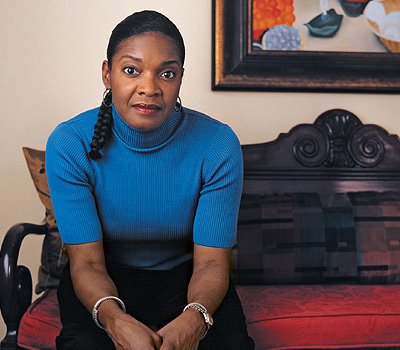


Karen Marshall Hudson, 43, of Houston, worked for 12 years as a bank vice-president at Chase and was a manager at Enron when it crashed, wiping out a chunk of her 401(k). She is now director of community outreach at the Houston Metropolitan Transit Authority. While she likes the idea of investing a portion of her payroll taxes, the Enron experience left her with a diminished appetite for risk.

Lest anyone forget, Enron is the lodestar or posterchild for the anti-business crowd. One, out of 14,000 public companies commits fraud and anti-Businessweek will never lay the issue to rest. Does anyone really think that Karen was randomly selected?

I wish this blog was more about social security and less about partisan psuedo-journalism, but reading this article last week put me in a sour mood. Social security may be a complex socio-political problem but it's a very simple economic one.

First of all, there isn't and never was a trust fund. Social security revenues have never been segregated. They get lumped in with all other government tax revenues. The whole "I paid in....so I should get my benefits..." doesn't hold water. No one ever paid in, they paid their social security taxes to the government in exchange for only the promise of future payouts. These people have forgotten the major intermediate step - that they elected politicians for 70 years that squandered their money and effectively reneged on all promises. Today’s youth and future generations will end up bearing this burden. It amazes me that anyone with children and/or grandchildren, perhaps the editors at Businessweek, could rationally see social security as a mere political football.

As this article mercifully ends, the authors lament:

But in today's hyper-partisan climate, the fight over the ownership agenda has taken on a larger dimension…
If these authors want relief from the “hyper-partisan climate”, maybe they should step out of the Businessweek office for a few minutes.

Saturday, May 21, 2005

It is not an SUV….it is a CAR !!!!


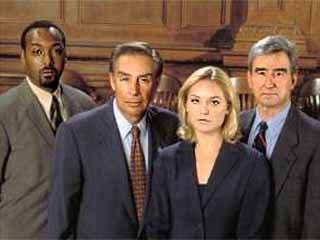
Watching Law & Order the other night got me riled up again at the anti-SUV nonsense.

On this latest episode, some guy tried to commit suicide by crashing his “SUV” into a commuter train. Of course he ended up killing 12 train passengers...

In the show, they must have said, “SUV” 50 times or so it seemed. Nobody but these anti-SUV whackos uses the term “SUV”. It is just a “car” to everyone else.

I take my Ford Explorer to the CARwash and put my infant son in a CARseat. Probably no one has ever asked, “where can I park my SUV?” or “should we take your SUV or my SUV?”

“SUV” has turned into a propaganda term by the agitators of class warfare. Google “SUV” and stories like this, this, and this will dominate your search results.

More propaganda:

Here's a headline from the Boston Globe (February 2004): "Teacher dies after SUV strikes her in driveway." The subhead lets us know that her ex-husband is to face murder charges. Ah. So an embittered ex runs down his wife, but the SUV did it. Would a BMW have killed her any less? I'm just asking.

Here's the Alameda Times-Star (September 2003): "Swerving SUV kills 92-year-old woman." If we read the story, we learn that the woman was killed when the SUV was sideswiped by another car, forcing the SUV onto the sidewalk. And what was the make of the swerving car? Doesn't say. Doesn't matter. What's significant is that the SUV killed the poor woman.

Here's a CBS Internet headline from November 2004: "Man dies in SUV accident on Long Island." You'd think the SUV picked the man out of a crowd and iced him. In reality, the man crashed his Ford Explorer into a cement barrier after sliding on a rain-slicked road. Presumably, he'd still be alive if he'd been driving a different vehicle.


On my recent trip out to Asheville, I decided to scream every time a so-called fuel efficient car cut me off,sped by, or dangerously weaved in and out of lanes. (Those little cars with the fluorescent, lit-up license plates seem to be disproportionately dangerous.) I was yelling my head off for the whole trip much to the dismay of my captivated passengers. The point of my histrionics was to show the idiocy of the “SUV drivers are more dangerous” canard. Yes, I have seen the dubious insurance reports that try to show SUVs involved in more accidents than other cars. These conclusions are so specious it chafes me to have to debunk them. None of these studies consider the other multitudinous factors in car accidents. For instance inclement weather – the anti-SUVers point out that smaller cars don’t get in as many accidents in rain, ice, etc. But maybe owners of these cars don’t drive when the roads gets dicey. Or maybe weather, and not car type, is the main factor in accidents and people in climates prone to these conditions just don’t buy the so-called fuel efficient cars in these areas.

They have theories that smaller cars are vulnerable and so their drivers drive more defensively. In contrast, SUV drivers feel safe and secure (remember they think they own the road) and therefore drive recklessly. The propaganda is unending and it demonstrates what an otherwise unnotable teacher of mine one said, "...if you look for the negative in something you are always going to find it..."

Here is a well written hit-piece on SUVs. He gets in nearly all of the anti-SUV talking points and even provides a few links to back his claims. He describes SUV owners as stupid, environmentally irresponsible, reckless, victims of false advertising, arrogant... This article couldn't illustrate any better my claim that anti-SUV sentiment is a briocolage complaint and a weapon of class warfare.

One claim he did not source is "97% of all SUV's on the road are single occupant..."

As I have pointed out before when discussing the oversimplified miles per gallon metric of choice for anti-SUVers, if there are consistently more passengers in SUVs than in other cars, their metric is not relevant. All I could find to support this (other than common sense) was an older study that ranks SUVs ahead of subcompact cars in terms of passenger miles per gallon.

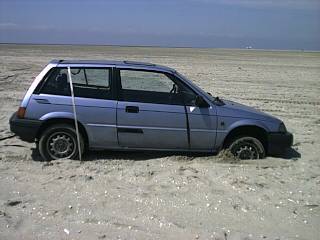
Taking off for a week to drive my SUV, I mean CAR to the Outer Banks. If I don't see any fuel efficient cars stuck in the sand, will that mean that the Prius, Accord, et al are good off-road vehicles? I guess by some people's logic.

Wednesday, May 18, 2005

UN-believable


Personally, I think the United Nations is a joke and should be expelled from Manhattan. But this story I read today is absolutely crazy.

Instead of kicking the UN out, the federal government is loaning it 1.2 billions dollars to renovate its headquarters. The problem is, that based on what numerous real estate developers have appraised, using square footage and considering possible rates for renovation, this figure of $1.2 billion is multiples of what it should cost. Donald Trump told Kofi Annan that he would do it for under $500 million and got no response. In fact, forget renovation, Trump just spent only $350 million to build a new 90 story building.

This last paragraph of the article I read is particularly nauseating.

American taxpayers have a legitimate interest in knowing the answers to these questions. The renovation is to be financed by a low-interest, 30-year, $1.2 billion loan from the U.S. government. (Kofi Annan's original request for an interest-free loan was turned down.) And, of course, the loan will then be repaid largely by American taxpayers, who foot a little over 20 percent of the U.N.'s bills.
Here is the entire article.

Tuesday, May 17, 2005

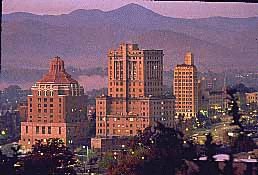
Asheville, North Carolina


Unfortunately I am moving my family (not by choice) back to Boston this summer. So we are trying to do as much as we can down here before we start serving our sentence in that bastion of bitterness. Last weekend, we ventured to Asheville, North Carolina.

It is a beautiful part of the Appalachian mountains, that is almost spoiled by the kooks that populate the area. Asheville is a place whose reputation precedes it. Having been to New Paltz, New York, I knew what to expect: dirty white college kids with dreadlocks, old tiny cars ridden with political bumper stickers, T-shirts like this, very lazy street musicians, girls without earrings, flyers for trans-gendered conferences, etc.

I turned on the television to some Asheville channel and what did I get – a documentary lecture on global warming. I open the hotel restaurant guide and I must have seen the expression “locally owned” fifty times. “Locally owned” is commi-speak for “not owned by evil national corporations.” I glance at a local newspaper and these are the headlines:

US Troops Accused of Arms Theft in Columbia…

Groups Push Bible as Public School Text…

Iraq Begins Corruption Inquiry…

Secrecy and Propaganda Sweeping US…


The paper was the Asheville Global Report. I went to their website today and got this:

Are we finished?

Unless something dramatic happens right away, the editorial collective of Asheville Global Report is sad to announce that this will be the last issue. We're not kidding.

Many of you reading this message may be familiar with our pleas every fall and spring for public support to cover our operating expenses. And miraculously, for over six years every fundraising season has found the newspaper literally snatched from the jaws of death by public support. Perhaps we have described this dependence and have desperately begged so much in the past with somehow surviving each time that by now a "cry wolf" syndrome has set in. But the fact is that every single time — every season — this desperation has never been exaggerated.

But this time it's different. It's been bad before, but never this bad. This is not a "Spring Fund-drive" letter. We're seriously in crisis —bankrupt with no guarantee that we'll be able to publish next week. We're publishing this statement as one last attempt to immediately rouse the support we need to continue. The situation is that we owe our printers thousands of dollars, rent is due this week, and we have to decide if it's time to figure out the best way to cut our losses by redirecting our attention to paying off our debts and rebating our subscribers.

This past year has seen a marked decline in support for AGR — in community funding and in the level of volunteer commitment needed every week to produce the newspaper. It's been so disastrous and unsustainable that we're now forced to ask ourselves if we should be reading this lack of enthusiasm for our efforts as a sign that people generally don't care whether or not the paper's around.

We're fully aware that it is no easy task to run an all-volunteer, non-profit, weekly newspaper. Maybe that's why you don't see more newspapers like ours in other cities. We feel lucky that we've managed to get by this long the way we have been doing things. The reality is that we always seem to have just enough volunteer power to churn out the production of the newspaper, but absolutely no one dedicated to raising money, writing grants or soliciting advertisements. We have no salaried employees, and none of us can personally afford to finance this operation. And it's pretty hard making sure all our bases are professionally covered at AGR at the same time as keeping ourselves personally afloat with meager-paying, part-time work and by keeping burn-out just out of reach.

We admit that this is not a sustainable management model. But in order for things to change so that this isn't the case, we need to know right away that we're still even wanted and that we'll be given the chance to do it. So unless people step up and donate or advertise RIGHT NOW, AGR's demise is imminent. Look at this would-be farewell as our last message in a bottle for help. Hopefully, enough loyal, generous readers will read this and respond with emergency donation money to buy us some time and keep us going for a couple more weeks. We hope this happens, while understanding that this is not a sound, long-term strategy, but a last grasp, break-the-emergency-glass measure. If not, thanks for your support all these years, good luck out there, and goodbye.

Sincerely,

The Asheville Global Report
Editorial Collective


Obviously that is the type of article that I can’t link to, since the site may be gone tomorrow.

There was one response posted (not by me):

Well, in the market place of ideas, apparently your distorted perspectives are just something that people aren't "buying." Not all that much different than a company marketing a product that has no viable market and the company goes under. Maybe if some of you are introspective enough and have minds that are open to other perspectives, you may well understand that your product is not viable... I seem to recall a statement that if ignorance is bliss, then liberals must be in nirvana... good luck finding real jobs that contribute to society. Then y'all can simply join the multitudes of street people in Asheville who think they deserve to be supported by those whom they ideologically detest. I am happy to hear of your impending demise...

Art M


On the subject of imploding newspapers. The New York Times is going to charge for online access to much of its content, $49.95 a year.

There have been rumblings of this off and on for quite some time. From back in January:

"It gets to the question of how comfortable are we training a generation of readers to get quality information for free," Arthur O. Sulzberger Jr., the paper's publisher, is quoted as saying in the article. "That is troubling."

I have to give Artie credit. I didn’t think it was possible to cram that much arrogance into one sentence. First of all, no matter what the Times does, it is not going to alter the economics and realities of the internet. Net surfers want free information and the only industry that has been successful at charging for online content is the porn biz. When sites so much as require free registration, their web traffic plummets.

And “quality information”? That is quite condescending to every other publication or site that posts content for free. Aren’t public libraries free? Is there no quality information there?

This Sulzberger lives on another planet. From a speech he gave in February.

On the charge of liberal bias, Sulzberger laughed.

"I hear more complaints that the newspaper is in the pocket of the Bush administration than that it is too liberal," he said.


Maybe he should read his own paper. In July 2004, his own Public Editor penned a column titled, “Is The New York Times a Liberal Newspaper?” with the upfront conclusion of “Of course it is.”

The Times was careful not to make the entire site restricted to paid subscribers. Maybe they think their editorial page is the big seller for the paper. I have no idea. Overall this is not a very risky move for the Times though. If their website hits drop and advertising suffers more than they take in from paid subscribers, they can always go back to the all free model. Correct me if I am wrong, but didn't television networks survive for years solely on advertising dollars?

Anyway I don’t want to make Times bashing, although a cottage industry in and of itself, a focus of my blog. I think that this move towards a paid subscription model is a dubious business decision; it reeks of arrogance, and demonstrates even further that the MSM (Mainstream Media) doesn’t understand the internet paradigm shift. If the Times was smart they would focus on lowering their bloated editorial budget and expanding their customer base.

The New York Times recent actions: trying to charge for editorial content, touting their "readership" metric, spending $400 million for about.com (link), buying half of the Boston Metro (link), etc. reflect more hubris than business prudence.

The Obesity Police


Like almost everyone in Charlotte, North Carolina, I am a recent northeast transplant. All this year I have had to explain to my residual northeastern family and friends why I love it so much down here (mostly because of the people, the weather, the golf, and the cost of real estate). I was even recently mocked for my effusive Charlotte praise by a bitter Bostonian. Of course, I have lived up there whereas he has never set foot in the Queen city. Just about everyone who has bothered to visit has left in accord with me on Charlotte’s merits.

The misconceptions about Charlotte, and I guess the South, run rampant up north. At some point I will do a Charlotte blog. But one question that I have been peppered with quite frequently is “Is everyone fat down there?”

My answer: “No”, “I don’t think so”, “….and who cares what other people weigh anyway?”

Before I discuss the nascent Obesity Police, I want to address the economics.

First of all, unbeknownst to most people, food is extremely cheap today. Americans spend only 6% of their personal income on food. That is down from about 16% in 1950. Food prices have been in constant decline for over 100 years.

Daniel Akst writes:

“In America today, food is cheaper than it has ever been. The Federal Reserve Bank of Dallas reports that in 1919 the average American had to work 158 minutes to buy a three-pound chicken; nowadays, 15 minutes get you the bird. Americans spend less than six percent of their after- tax income on groceries, a figure so low they can afford to spend another four percent eating out. It's likely that in no other country is food as cheap as it is in the United States . The U.S. Department of Agriculture, using 1996 data, reports that the Japanese spend 16 percent of disposable income on food, and the Germans 17 percent. But even those figures pale in comparison with Third World countries. People in India , for example, still spend nearly half their disposable income on food.“

Now this explains why our grandparents are so fanatical about saving leftovers, bacon grease, and their doggie bags. (I know a caterer who tells me that the grandparent demographic often asks for doggie bags at wedding receptions!)

Contrary to popular opinion, people don’t eat out more now because they can’t cook, that is mostly a side effect. People outsource meals because of cost and time-saving factors.

“In 1919, after all, you not only had to work 158 minutes to earn that chicken; you also had to spend a lot of time plucking it, cooking it, serving it, and cleaning up afterward-instead of just stopping at KFC on the way home from work.”

Back to the Obesity Police. There are many people, and I can’t really stereotype all of them, that believe obesity is a nationwide problem and a ripe subject for vilification. Much like the anti-SUV crowd, this anti-obesity crusade is also a bricolage complaint and a weapon of class warfare.

The only effect that obese people could possibly have on others is through higher healthcare costs. But here we go again. The fomenters of class warfare are trying to parse the price of healthcare into the healthy and the unhealthy demand components. Just as those irresponsible gas-guzzling SUVs are driving up the price of oil, the obese are strangling our healthcare system.

If the Obesity Police stuck to the healthcare argument and suggested that HMOs be allowed to price discriminate on weight issues for its enrollees, I wouldn’t have any problem with them. After all, life insurance companies do this all of the time – their rates are based on age, health history, smoking or non-, etc. Anywhere you see a “one-price for everyone”, it is pretty much a certainty that price will be high.

But solutions and economic reform don’t concern the Obesity Police. They claim to be looking out for public health, but their criticisms smell more like politics, class warfare, and corporation bashing. If I blamed anyone, it might be insurance companies for not pushing for price discrimination. Or maybe I would just hold the “obese” responsible for their own plight. After all, there are plenty of stigmas and burdens inherent in obesity.

However, the real aim of the Obesity Police is blaming and castigating Corporate America. So the obese must be victims of profit hungry McDonalds, Coca-Cola, Hershey, etc. How surprising is it to see icons of capitalism targeted this way? Not at all these days. Corporation bashing has become a de facto weapon for econo-illiterate politicians, academics, and media.

One of these days I will blog about corporations in general: about the birth of the corporate structure and how paramount it has been for economic development and prosperity. Corporations allow investors to pool capital, limit personal liability, and have fueled the entrepreneurial risk taking needed for economic growth. Do you think the owners of Newsweek want personal liability for the 15 dead from their Koran-in-the-Toilet debacle?

John Edwards and his trial lawyer brethren are licking their chops at the prospects for obesity class action suits. It worked for tobacco and asbestos, but I am cautiously optimistic that it will fail this time. Nonetheless, fast-food companies and other purveyors of fattening foods have modified their fat and sugar contents and started offering healthier products. This won’t stop the Obesity Police and its agitprop (Super Size Me and Fast Food Nation), but they are at least prepared to fight this legal war. It is amazing how food and every other product has to have warning labels and nutritional information on it, yet I have never seen any such disclaimer on a newspaper or magazine. For instance, "Reading this paper could be hazardous to your brain, and it may cause paranoia, delusion, or constipation..."

Everyone knows that big was beautiful a few hundred years ago, but now that food is cheap, obesity is a “socioeconomic” epidemic. Click here to see a racial breakdown of obesity state by state.

That hyperlink and politicos like Jesse Jackson explain why health insurance companies can’t charge higher premiums to insure obese people.

I mostly don't care about this alleged obesity epidemic. Yeah, they shouldn't sell Doritos and soda in public schools, but this isn't the cause of obesity. At best, eliminating junk food in public schools would be more symbolic than efficacious. I have a better solution, eliminate free lunch programs. This would save the financially strapped schools systems and would target the "socioeconomic" demographics most in need of help. I am seriously for the elimination of free lunches but the "socioeconomic" argument was tongue-in-cheek. Junk food in schools - that is about 100th in the hierarchy of public school problems. If they ever do lose the junk food, you can be sure there will be little junk food stores opening down the block from many schools.

Fast-food is a product of cheap food and cheap food is a product of capitalism. In other words, you can't have capitalism without cheap food, they are born of the same market forces. Read Daniel Akst's entire article. It is long but very informative.

Tuesday, May 10, 2005

Template News

As a youth in Massachusetts, it didn’t take me long to see the predictability of local newscasts. It was the same everyday, someone got shot in Dorchester, and somebody got stabbed in Mattapan, some days it was vice versa. Reporters would be on the scene and get comments from the victims’ families. Why news stations thought their audience wanted this same dribble everyday was beyond me. Partially I think it was born out of journalistic laziness.

Nowadays this is referred to as “template news” and it extends way past nightly local newscasts.

Check out the oops, from the NY Times website in reporting the Pope’s death. click here. you can double click on the pic to enlarge.


If that isn’t a template, I don’t know what is. To me, “template news“ is a powerful disincentive for consumers to buy newspapers. Why read a paper when you know what it is going to say?

Newspapers have been losing readers on a persistent and widespread basis for some time now, to the tune of 1 to 4 % nationwide over the last year. For links, click here, here, and here.

The reasons for newspaper decline are multivariate (competition from cable news, the internet, “template news”, political bias, etc.) and the publishers’ excuse is as lame as they get. They cite Do Not Call legislation as the culprit responsible for subscriptions declining.

The Wall Street Journal article linked above states that as much 60% of new subscribers have been signed up via telemarketing. But some basic math implies that papers are still signing up new subscribers and therefore the problem is really existing customers not renewing. Every business has new hurdles to clear each year. It is not like the Do Not Call List sneaked up on them. I am sure they implemented failed counter-measures, which go conspicuously unmentioned. To newspaper executives, it is much more palatable to blame an exogenous event for the business falloff, than it is to blame themselves.

Lets play some $100,000 Pyramid.

“Maybe our politics offends some readers…”

“Maybe perpetual negativity isn’t so marketable…”

“Maybe our news gathering budgets are too high…”

“Maybe we haven’t embraced the internet…”

What is the category?

If you guessed, “Things a newspaper executive would never say to explain declining circulation...”, then you are correct.

In fact, true to their elitist core, now the New York Times is trying to tout the quality of its readers, at least to its advertisers. Furthermore they are trying to change the metric from a circulation model (number of papers sold) to a readership model (number of times a paper is read, per sale). I can’t find the exact statistic, but they have determined that each paper they sell gets read by 3 to 4 people, highest in the industry, and they want their due credit. This may make the Times management feel better about themselves, but it won’t sway any advertisers. They are already aware of how often a paper gets read and it is already priced into their rates.

This metric switch (to a readership model) is nothing more than a marketing ploy quite redolent of some of the bull market dotcoms. Many of these upstart internet companies incessantly touted their price-to-eyeball and price-to-click ratios. That old metric called profit? That was defunct. Okay, maybe this analogy is a stretch, but the similarity lies in the self-aggrandizing metric selection.

The MSM has been excoriating corporations about accounting and financial transparency practically nonstop since the Enron debacle. Yet ironically enough, the New York Times won’t breakdown its editorial budget for Wall Street analysts. Its editors obviously spend a boatload of money ($80 million per year?) on unknown travel and opinion column expenses. The Times management clearly doesn’t want analysts or shareholders to demand or even suggest any fiscal prudence. Remember the Times is a publicly-owned company. I guess shareholder rights and corporate transparency only apply to OTHER public companies.

UPDATE – Remember my blog on Internet Luddites? Well a mere week later, the New York Times weighs in on blogs. Click here for article. Guess what they think – well it isn’t much different from the content of that anti-Businessweek article. They even used some of the exact same expressions like, “…should be a clear wall between editorial content and advertising.” Perhaps there is a talking points memo on blogging making the rounds. Talk about “template news.”

Who is the exalted author of this latest blog-bashing screed? One Mr. Adam Cohen, a guy so web savvy that he doesn’t even have an email address.

What next? Is the Times going to have this guy...


...write an editorial on anger management?

Let me just say that the New York Times total readership model should be adjusted. They should net out the buyers and readers who are only interested in the crossword puzzle. Furthermore, I think the total readership number should then be reduced by a coefficient of constipation. I am serious, they can hire a scatologist to estimate, based on readership demographics, how many readers could be using the Times primarily as a laxative. From this data they would have to revise downward, the readership numbers because if reader number 1 gets the paper first and is in the constipation demographic, then there is no way readers 2,3, and 4 will touch that paper.

Miscellaneous

Last week, while waiting in line at a Bank of America branch, I glanced up at a prominently placed dry-erase board to inspect the day’s advertised mortgage rates. It wasn’t a second before I was accosted by a bank rep asking me if I was buying a home and needed a mortgage. I was shocked. In 15 years of personal retail banking I have never seen anything like it. Next time I go there, I will be sure to turn my head far away from that board. This is akin to avoiding eye-contact with aggressive panhandlers.

UPDATE – The next time I went into the bank, upon making a deposit in my son’s account, the pubescent teller tried to sell me a 529 account. Still perturbed by the aggressive mortgage push of last week, I impolitely told him not to worry about my son’s college savings. After all, I am making him go ROTC.

$42,100 This is what it would now cost annually to send my son to my alma mater. 2004 UPenn tuition.


Using some algebra, 26,000*((1+X)^12)=42,000, and solving for X, I find that tuition has risen on average 4.07 % annually since my freshman year (13 years).

If tuitions continue to rise 4% per annum, my son's first year at UPENN will cost $85,286.

So sending three kids to college in 2023 would cost 3 * $85,286 * 4 years each = $1,023,442

I do not think it will eventually cost that much. Tuitions are already at untenable levels and these inflation rates will seemingly have to abate. At another time I will delve into the causes of today’s exorbitant tuition levels.

One quick note though. Probably THE main cause of ridiculous tuitions is the government student loan program. These subsidies start out with ostensibly the most innocuous and wholesome intention – that of making college education more affordable. But invariably, as with any attempt at price control, they end up distorting the economics of college tuition. Universities and colleges haven’t done anything to rein in their expenses. After all, why should they when the federal government will loan or grant all of the money its customers (students) need? Essentially, these schools have become little federal governments replete with all of the markings: expanding budgets, bloated administrations, entrenched labor (i.e. tenured faculty), and the defining characteristic - they are funded by public tax monies.

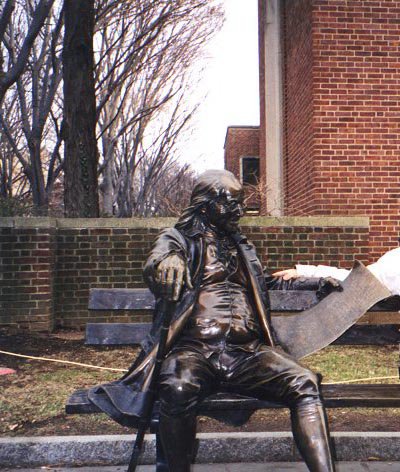
Ten years after I left UPenn, the campus is now almost unrecognizable to me. There are huge new buildings all over the place. UPenn has extended its tentacles in all directions. Sure they will say that a particular building was paid for by some rich alumnus, and they may even name it after them, but is that benefactor paying for added staff salaries and benefits, maintenance, heat and electricity, etc.? I think not – the students are.

How is college more “affordable” when students nowadays are graduating with upwards of $50,000 in loan debt?

Yes, I have seen those studies that “prove” that a collegiate education at today’s prices is a great investment because college grads will more than earn back their tuition costs through higher wages (than non-grads). What other conclusion would you expect from “academic” studies?

Thursday, May 05, 2005

Google


Between 1987 and 2000 the stock of Home Depot (HD) split nine times. A veteran trader I knew lamented one day, “I knew I should have bought that stock….the parking lot was packed every time I drove by.”

Many famous investors have suggested that individuals invest in sectors that they know. In this spirit, I bought some shares of Google in December. I wanted to buy it in the fall around $100, but I missed it and had to buy it at $177. Today it closed at $228 and I am really kicking myself for not buying it at $100. In the absence of a major price spike, I plan on holding this for a very long time.

Why did I buy it? Because I google about 20 things a day. Not only that, I see massive growth ahead. I don’t know anyone who googles nearly as much as I do. The future on this is so clear to me. More people will have broadband, internet literacy is only going to grow, wireless internet devices like blackberries will soon be as common as cell phones, and there will just be more and more googling.

Of course there is risk. Microsoft and Yahoo have Google in their sites. But Google has the head start. Remember everyone tried to start up auction sites to compete with Ebay and they all fell meekly by the wayside. Amazon defeated similar competitive threats. All Google has to do is hold off the upstart search technologies of Microsoft and Yahoo and it will solidify itself as a very profitable monopoly.

At $228 per share, Google seems quite expensive. A mere 50 shares costs over $11,000. After all, how excited can someone get about owning 20 or 30 shares of a stock? To counter this, I am reminded of a guy who told me that he put $2000 into AOL stock and it appreciated to over $100,000 at one point. My advice, buy some Google and forget about it.

Wednesday, May 04, 2005

Internet Luddites

I remember 5 years ago, I was meeting with a headhunter and she asked me if I was working with any other headhunters. I responded no, but added that my resume was listed on monster.com. She laughed her ass off at me and exclaimed, “no one uses monster.com”. I told her that I had gotten a few job interviews from it already. Yet she could not contain her derision or condescension. Now, 5 years later, nobody uses headhunters. And those headhunters that are still in business, they ALL scan monster.com for candidates.

I could tell a similar story about real estate agents and craigslist.com in New York City. They all scoffed at the idea of landlords listing apartment rental ads online, rather than trying to rent through their agencies. Now those same agencies ALL list their units on craigslist.com and they ALL use the site to troll for more business themselves.

Even last week, someone challenged my use of craigslist.com to determine the market price of a two bedroom apartment rental in Brooklyn Heights. I had written that the rental price is “around $2000 a month”. I should have written more precisely that it is around “$2300” a month, which doesn’t change the Rent versus Buy argument much at all. (compare $2300 a month to $3300 in mortgage payments + probably $1400 in maintenance and taxes + insurance, etc...) He told me that I had to look in the NY Times to get the real market rental rate. I respectfully disagreed. Craigslist.com has 117,000 listings under NYC Housing. Also, most of the NY Times listings are posted on Craigslist.com as well.

Moving along…

The headhunter and real estate agent anecdotes illustrate the word of the day:

Luddite – 1) any of a group of British workers who between 1811 and 1816 rioted and destroyed laborsaving textile machinery in the belief that such machinery would diminish employment. 2) one who opposes technical or technological change.

The term is mostly used generically now to describe those that resist progress. I could understand being an internet Luddite back in the 1990s, but anyone who belittles the internet now is just plain foolish. Yet I can hardly go a day without hearing or reading someone disparage the net. The criticism is usually predictable in both source and content. It mostly germinates from old entrenched interests (MSM - mainstream media, politicians, business, higher education, …) and from people that either don’t use the internet or haven’t really harnessed its potential. The substance of these complaints is invariably an assault on the veracity or origin of web-based information. This really is an ad hominem attack on the whole web – and it is quite ridiculous.

So when I saw anti-Businesweek’s cover this week, “Blogs Will Change Your Business”, I could pretty much predict the tripe they would call an article. Look at these excerpts (parenthetical remarks are mine):

Most of you are sick to death of blogs (QUITE A PRESUMPTION)

And yes, there's plenty out there not to like. Self-obsession, politics of hate, and the same hunger for fame that has people lining up to trade punches on The Jerry Springer Show. (NOTHING TO LIKE?)

Name just about anything that's sick in our society today, and it's on parade in the blogs (HOW ABOUT MAINSTREAM MEDIA?)

On lots of them, even the writing stinks. ( read: BLOGGERS ARE RANK AMATEURS)

Let's assume that 99.9% (of blogs) are equally off point…. (SO FAR 99,9% OF THIS ARTICLE IS “OFF POINT”)

If it's scandalous, a poisonous e-mail from a CEO, for example, or torture pictures from a prison camp,…

And here's the killer: Blog posts linger on the Web forever. (“LINGER”?)

Whether at newspapers or global manufacturing giants, they decide what the masses will learn.

This elite still holds sway at most companies. You know them.

This raises all kinds of questions about the ever-shrinking wall between advertising and editorial.

Any chance that a blog bubble could pop?
(LUDDITE WISHFUL THINKING)

The difference is that while dot-coms promised to make loads of money, blogs flex their power mostly by disrupting the status quo.

A prediction: Mainstream media companies will master blogs as an advertising tool and take over vast commercial stretches of the blogosphere.
(MORE WISHFUL THINKING)

....and earn some pocket change

Popular blogs can land sponsorship deals for as much as $25,000 per month, say consultants. O.K. money for an entrepreneur, but a rounding error in the ad industry.
(IF THIS WRITER COULD BLOG FOR HALF OF THAT, HE WOULD QUIT BUSINESSWEEK IN A NANOSECOND.)

The big companies have what the bloggers lack. Scale, relations with advertisers, and large sales forces. They can use these forces to sell across all media, from general audience to bloggy niches. (MORE SELF-SERVING WISHFUL THINKING.)

All of this nonsense is in an article ostensibly about how blogs are changing businesses. The only business blogs are drastically changing is the media business. While blogs “linger forever”, in the past, the content of media companies did not. So pundits, journalists, and other mouthpieces could pretty much be wrong with impunity. It used to be much tougher to keep track of who said, or did what, when, or where. Now the moment a falsehood is published or broadcast, my blogging cohorts are all over it. One would think the media companies would appreciate this free editing and fact checking service.

Question: if blogs are just poorly written and unreliable garbage, beneath the concern of real advertisers, why did Businessweek devote its frontpage and lead story to such an irrelevancy?

The next time someone bashes blogs, ask them to name the most popular blogs on the net. I will bet you that they can't. It is almost needless to say that they haven't read them either. If someone wants to learn about blogs, I suggest they read blogs and not Businessweek.

Anyway, here is the link to that article.

Wednesday, April 27, 2005

The Business of Terrorism

Remember the criticism leveled at all of the 9/11 souvenir sellers around Ground Zero?

Here is the latest hot item from J-Crew.

.

Embroidered djellabah
Our lightweight linen tunic, inspired by the original tunics from Morocco...


No longer does a teenage girl have to get a tattoo, a nose ring, or date an older freak to piss off her parents. Now she can dress like a terrorist. You have to love teenage rebellion.

While my wife is irate at J-Crew for this, I have a divergent point of view. I feel J-Crew is providing a service - that of separating fools from their money. Or at least taking it from their parents. $98, plus shipping and handling. Here is the link.

Monday, April 25, 2005

Evil SUVs

I have been planning to address SUVs for a while and as expected, with gas prices rising they have become quite the hot button issue. I just googled “high gas prices suvs” and got an ABC News story from today that almost hit the nail on the head – in terms of what I was looking for. ABCNEWS.com polled its readers “How they felt about the idea the SUVs and pickup trucks might be hit harder by rising gas prices.” Of course they got an enormous response and published 4 pages of feedback. This article was unmitigated vitriol and could make almost anyone’s blood boil (on either side of the issue).

I always thought that the anti-SUV sentiment was two-fold, "global warming" and about bidding up the price of gas/oil. But I have learned that the loathing runs much deeper. SUV antipathy is more of a bricolage complaint and a weapon of class warfare. Here are some excerpts:

"I have hated SUVs and the mentality that gave birth to them since the early '90s when I was in high school, and will continue to hate them and the people that drive them with a righteous anger for as long as I draw breath," wrote Andy Bliss of Los Angeles. "On a daily basis, I let these people know my feelings with my car or a few fingers/choice words. I despise their selfishness, avarice and soul-less need to endanger others for their own comfort. I laugh as I fill my economy car for a fraction of what they do, watching them wallow like the pigs they are in their putrid opulent consumerism."

"I am less than secretly glad when I hear the agony of the SUV people paying $60 to $70 a week to fill their tank," wrote Bernard K. Addison of Los Angeles. "We do not need the size, we do not need the inefficiency, and we do not need the attitude of road ownership and invincibility that reflects in the driving patterns of the majority of SUV owners."

"It's good to see all these arrogant drivers of gas guzzling road machines end up paying half a week's pay to fill up their monstrous machines," wrote Brian Silver Fox of Hammonton, N.J. "I am far from an environmental activist, but there is no reason why anyone needs these vehicles, ESPECIALLY Hummers (which, like assault weapons, should be reserved for the military). I truly enjoy seeing all of them driving around with their jingoistic little magnets on the back, supporting our troops, who are dying simply for their 'right' to own these stupid machines."


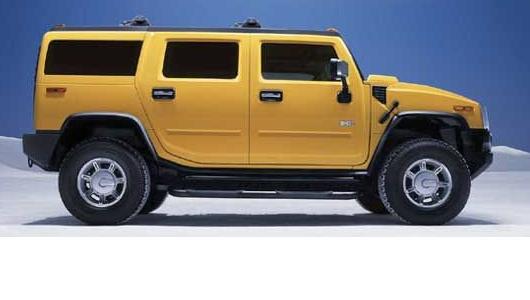
"The SUV I hate the most is the Hummer H2," wrote Scott Cohen of Melvindale, Mich. "Every chance I get, I will flip them off, regardless of whether the driver sees me or not. Hummers are the most obnoxious and rude vehicles for people to use to show off how much money they are making, and that they stick their noses up at the rest of us while driving their $65,000 SUV that is a gas hog and is no good for the environment. I do smile when I see them pulling up at a gas station and spending over $60 on one tank of gas, though."

"What many SUV drivers may fail to realize is that the reason for high gas prices now is the massive demand for gasoline, spurred in part by people like them," wrote Daniel Smith-Weiss of Bedford, N.H. "SUV drivers have in part brought these high prices on all of us. So I do get a small sense of satisfaction seeing them pay so much more."

"What I don't like about SUV drivers is their reckless and negligent way they drive," wrote Judith A. Gill of Baltimore, "as if to say 'I do whatever I want on the highway because you can't hurt me but I can demolish you, so get out of my way.' They don't care about gas prices. They think they are superior to everyone else on the highways and roads of this country."

"I don't feel sorry for drivers of SUVs paying huge sums to fill up their gas guzzlers," wrote Peter Bowler of Dallas. "They are half the reason the gas prices are so high and our air is so polluted. I hope the high prices will keep these enormous pieces of crap off the roads."

"Although I don't like the high gas prices that I have to pay for my cars, I don't mind a bit that the SUVs, full-size vans and pickup trucks get hurt by the high prices," wrote Ed Caldwell of Bloomington, Ind. "Some of the drivers of those vehicles drive as though they are above the law. The police are afraid to stop them because they can't see their hands or glove compartment."

"The reason that people with SUVs are not suffering more from high gas prices has got to be because they are wealthy to begin with," wrote Scott Hartman of Toledo, Ohio, who said he drives a small pickup truck and feels the pinch. "You have to be rich to be able to pay $40,000 [to] $50,000 or more for an SUV. They have money to pay for the gas."

"I would like to see gasoline prices rise to $4.50 a gallon or higher," wrote Richard Lane of Prescott, Ariz. "I would like to see a stiff tax levied to bring up the price to what people in Europe pay. This is the only way that Americans will change their gluttonous habits."

"It's amazing all the cars that I see with one person driving in a SUV on the freeway in Houston," wrote Debbie Mejstedt of Friendswood Texas. "I hope the price goes up to the same that it is in Europe. Maybe then people will think twice about their selfish gas guzzling tanks."


Like I said, unmitigated vitriol. As these comments demonstrate, the anti-SUV sentiment transcends energy prices and "global warming".

A couple of quick rebuttals. My evil and irresponsible 2000 Ford Explorer cost $11,000. We bought it because we didn't want to shell out $18,000 for a fuel efficient Toyota Camry with 60,000 miles on it. I also don't remember seeing low prices on any BMWs, Porches, or Audis. So the SUV is not the vehicle of the rich.

I love these people that want gas prices to rise to European levels. Maybe they want the higher European tax and unemployment rates as well. I'll bet the Europeans want our gas prices.

"The SUV I hate the most is the Hummer H2," wrote Scott Cohen of Melvindale..." Does this guy really sit at home and rank his hate of different SUVs? Scott, you are at a minimum, a total loser.

This business about SUV owners being bad or dangerous drivers reeks of delusional paranoia. In fact, I think that driving ability is the one trait that is constant across all demographics. Pick any group or class of people and I can find someone who will say that they are the worst drivers. Young, old, male, female, black, white, Asian, Hispanic, and I am sure liberal, conservative, republican, democrat,... No way SUVs are THE choice of bad drivers. By extension then, you would have to say that all rich people, since they own the SUVs, are the worst drivers. This is nonsense. I never noticed any extra recklessness in SUV driving long before I became an owner - and road safety is a particular peeve of mine.


Now back to gas prices. A favorite tactic of the econo-illiterate is to pit consumers against each other. First they pick who the evil one is, then they create the fallacious argument blaming him for the perceived ills of the righteous consumers. Medical costs are increasing, so blame the obese. When consumers run up credit card debt, blame the "predatory" lenders.

(Just last week, when a Red Sox fan reached over the wall and touched Gary Sheffield and another fan "spilled" his beer on him, the Boston Globe ran a cover story blaming larger beers and more beer stands at Fenway. Never pass up a chance to blame evil business. click for story)

So with gas prices rising, the econo-moronic invariably start the blame game. To them it is this simple, SUVs get fewer miles per gallon, hence their owners are irresponsibly bidding up the price of gas to these high levels. The anti-SUV crowd is unanimous on this point.

Here is how that fallacy breaks down. Last year a relative of mine expressed his displeasure with me owning an SUV. I asked him how many miles a year he drove – 25,000 he replied. I told him that I drive 10,000 a year and there are usually three people in my car to his one. So who is really the gasoline glutton here?

The econo-illits choose the metric that suits their argument. If miles per gallon is the metric, then they can condemn all SUV owners. How convenient. Figuring out total miles driven or total passengers would muddle their argument and is by necessity ignored. So you SUV haters, before you flip off the next Hummer, consider that behind those tinted windows, even a below-average sized “posse” would make that Hummer more fuel efficient on a per person basis. (Consider also that flipping off Hummer drivers could also get you shot.)

This class envy tactic never works. As much as some academics or economists would like to do it, one cannot quantify what specific consumers contribute to the price of a good. This exercise is just way too multivariate and lends itself to manufactured conclusions.

My 25,000 mile per year relative lives 40 miles away from his job. Imagine the stress on highway budgets if everyone did that. So maybe fuel efficiency is to blame here. If he was getting 12 miles per gallon, maybe he would be forced to live closer to his office. Maybe they should legislate that one cannot live more than 15 miles from their office. Or they could just legislate that cars can’t get more than 15 miles per gallon. That would do the trick. I am sure he would be amenable to all of this.

More class envy spin. What about all of these northerners spending each winter in old drafty homes? Aren’t they needlessly living up there when there is plenty of space in the temperate south? They are bidding up energy prices for the rest of the country and contributing to “global warming” more than the southerners. There seems to be a need for some forced migration here. Or maybe they should limit northern homes to 2500 square feet.

See how ridiculous this gets?

How is it that the SUV haters can bash the inefficiency of American cars and drive Hondas and Toyotas, but when elections come, they vote for anti-outsourcing and pro-union politicians? It is tough to keep up with these people.

About “global warming”, all I will say is that the theory won’t gain any traction until meteorologists can at least accurately forecast tomorrow’s temperature – never mind temperatures 10, 20, or 50 years out.

This topic is sure to be revisited. click here for ABCNEWS.com article.

Saturday, April 16, 2005

Marketing Hilarity

Marketing, the enormous and pervasive business of selling differentiated products. In our ultra-competetive economy, the ads can become more important than the quality of the products. But all too often, the marketing gets ridiculous. Consumers would be wise to ignore all of the packaging. This is a fun trick I use.


I mentally rename products and brands - but with the appropriate antonyms. If Weight Watchers became "Gut Ignorers", who would buy their products?

.

Go Lean becomes "Stay Fat".

.

The Baby Einstein brand becomes "Baby Moron" or "Baby Idiot".

Now for the worst offender:


"Rosie the organic range chicken enjoyed the good life before ending up beheaded, plucked, swathed in plastic and artfully arranged on a bed of ice at the Whole Foods Market in Glendale, Calif. Rosie spent life in a custom ranch house in California's wine country and exercised in an airy, sunlit building on an earthen floor covered with clean hulls of rice. She nibbled on golden corn and flew the coop in an outdoor yard. And unlike poultry sold at most grocery stores, this bird never used antibiotics or growth hormones.

That, at least, is the reassuring tale told in the brochure (printed on recycled paper, of course) available for discerning shoppers at the track-lit, pristine poultry cooler in Whole Foods stores. The real point: Rosie is priced at a princely $3.29 a pound, more than twice the cost of your regular bird."


click here and scroll to the bottom to see a side-by-side comparison of prices between Whole Foods and a local grocery store. I like how they call Whole Foods, "Whole Paycheck". What nut would pay $3.89 for a dozen eggs? How much extra does a cage-free egg white omelet cost?


Personally, I prefer the eggs from the tortured, death-row hens in solitary confinement.

(That entire article from above starts here.)

Gas Math


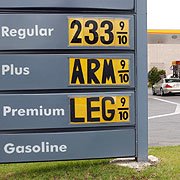
As I have noted in a previous post, gas is not at a record high when adjusted for inflation. But that doesn't stop the MSM (mainstream media) from their incessant bleat of "record high gas prices". If gas is at a record high, then so is almost everything else, including newspapers, movie tickets, college tuitions, cable television, etc.

Nobody likes to see the gas pump hit a number $5-$10 higher than normal when filling up their car. But just for fun, let's do the math on how devastating economically gas prices are for the consumer.

I don't drive much, only 10,000 miles a year. Now divide that by the 14 miles/gallon that my Ford Explorer gets and you arrive at 714 gallons of gas per year. So if gas went up $1/gallon, say from 2$ - $3/gallon, I would be shelling out $714 more per year. That is only $60 a month. And this also implies that if gas were to go up to $4/gallon, my monthly budget would be roughly $120 higher.

I can easily shave $60-$120 a month off of my budget, and I think most people can too. I know many people drive more than 10,000 miles a year and may have 2 cars in the family. Nonetheless, I would encourage them to do the math and see exactly how "devastating" gas prices really are.

Since the Sopranos are on indefinite leave, all I have to do is cancel HBO and my land-line phone to pay for the gas increase.


But if you have a 20 mile daily commute and drive one of these:


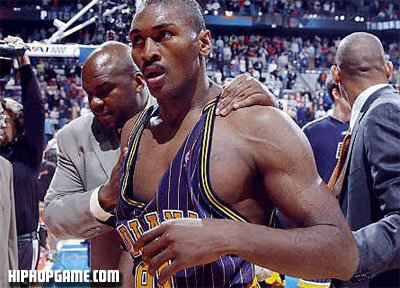
at 9 miles per gallon.....you are in trouble. I guess higher gas prices are rough on rappers and pro-athletes.

It really is amazing how many people feel that cheap gasoline is an entitlement. All of the small-minded econo-illiterate are scrambling to find out who is to blame for rising gas. They want home prices, stock prices, and the bond market to go up, but nothing else. It just doesn't work that way.

Being the outside-the-box thinker that I am, let me state that I actually am glad that gas is high. It really is very cheap to drive. Roads are crowded, no one car pools, public transit is under-utilized, etc. Mostly though, I think the major problem is that the development and maintenance of public roads is a governmental and taxing disaster. They haven't built new highways or bridges anywhere in years. I think that unless the cost of driving rises, in ten years this country will be one big traffic jam. If I were in charge..... I would make every major road a toll road and require each car to have an EZ-Pass or Fast Lane. This is the only way that you could get the actual users of a road to efficiently pay for it. The system we have now is somewhat socialist.

Monday, April 11, 2005

To Buy or to Rent, That is the Question


Now might be the worst time ever to be a first-time homebuyer in the US. To me, the buy or rent dilemma isn't a dilemma at all. If possible, one absolutely must rent instead of buying a first home. Now if somebody has tons of cash, four kids, or lives in an area devoid of rental property - they may justifiably ante up for a house. But most people are not in that situation.

A couple of quick points. House prices are substantially higher than their derivative rental prices. This means that a mortgage on a two bedroom apartment is a lot higher than its market rental cost.

Here is the quick and dirty analysis that I use. Consider that every $100,000 of house costs about $600 a month in mortgage payments. So the two bedroom units in Brooklyn Heights that were listing for $550,000 cost about $3300 a month in mortgage payments. Yet these units can be rented for around $2000 a month. This renting discount is not unique to New York, it is a nationwide phenomena.

I must have heard a hundred times in the last few years, "Well I don't want to piss away money on rent..." So instead these people opt to piss away money on interest. If you mortgage $300,000 at 6%, you will end up pissing away $1500 or so a month in interest. And don't forget real estate taxes, maintenance, PMI, insurance, and the costs of possibly moving later on. Suzy Orman debunks the "tax break" myth and makes a few other relevant points in the link below.

suzy orman

I know that if you go the adjustable route, you can mortgage $100,000 worth of house for $390 a month. Absolutely do not do this, unless you have cash on hand with which you could pay off almost your entire mortgage amount should rates spike. Rates are just off of 46 year lows - lock in a fixed rate and if they go lower, you can always refinance. For you ARM gamblers, don't forget that rates went above 15% in the early 1980s. Most people couldn't handle a move to 9%.

Suffice to say, I am bearish on the real estate market. Here are my reasons:

There are too many people buying today with adjustable-rate products and interest-only loans. Incomes are lower, particularly among young people, than they were 5-6 years ago. The Federal Reserve seems determined to prick the housing bubble. Inflation is taking root and has historically been anathema to interest rates. Half of new construction in Florida is estimated to be "investment" properties. Last year in California, half of new mortgages were "interest only". For more on the stupidity in the land of fruits and nuts, click on this link, it is unbelievable.

Anecdotally, I have come to the same conclusion. I know several people who have bought homes the last few years that have appreciated immensely - at least on paper. Almost without fail, each one of them has either taken out a home equity loan, built an addition, remodeled the kitchen, bought another piece of property, or moved into a bigger home with an increased mortgage. Rare is the story of a homeowner selling his house and downsizing to a smaller home, cheaper region, or RENTING. Here is the bull market analogy - did anyone actually dump their AOL/Time Warner stock when it was over $100 (currently $18 per share)?

In summary, I believe that incipient inflation along with coincident rising rates, will couple with super-leveraged buyers to create the perfect storm for real estate. I am predicting some serious economic pain within 2-3 years. Remember, a pendulum swings both ways.

(I am still shaking my head at that LA Times article.)

Sunday, April 10, 2005

Commodities


I had read, enjoyed, and learned a great deal from Jim's first two books and thus wasn't going to pass over his latest. With oil, gasoline, copper, gold,..... all exploding over the last few years, it would seem to the unknowing that this book is simply a potboiler. But Jim has been tooting the commodity bullhorn for years, although I bet Jim could definitely have written this book in a week. He made gobs of money investing in commodities, racking up 4000% for his fund in the 1970s and allowing him to retire at the age of 37. So he knows what he is talking about and that would be obvious to anyone who reads his work.

In the late 1990s, commodities were trading at Depression levels (adjusted for inflation). I read that Jim was starting a commodities fund and I seriously considered dumping some money in it. Of course, I never did and since its inception, his fund is up 170%.

So now, here we are 7 years later and instead of sitting on some nice capital gains, I am forced to consider buying now at much higher prices. Historically commodity bull markets last 17-18 years, so Jim is quite confident of another decade of great returns.

Now that is an incredibly scary prognostication. If commodities rise for the next ten years, there will be almost infinite pain in the stock and bond markets (and by extension the real estate market as well). While Jim isn't trying to convince anyone to swap all of their current investments for soy beans, lead, and coffee, he at least makes the argument for some diversification into the commodities sector as a portfolio hedge. Historically, commodities have a purely negative correlation to equities.

Much of the commodity story today is about China. Their rapidly growing economy has a seemingly insatiable demand for oil, copper, steel, etc. Count me among the many people that feel China is financial bubble ripe to burst. When it does, I will probably buy some commodities - no sooner. Though not explicit, it seems that the commodities Jim likes best are oil, lead, sugar, and coffee.

This book took me only one day to read and at a cover price of $25.95, I am glad I borrowed it from the library. I figure this a good way to recoup some of my tax dollars. I used to buy books new, read them, and then clutter my apartment with them indefinitely. Then I got wise and starting buying used books from Amazon. I read them and they cluttered my apartment as well.

Last year, I moved to Charlotte and got even wiser. They have a multi-million dollar high tech library. I can see the card catalog, reserve books, and even renew outstanding books online. When you reserve a book that is currently out, a computer will call you at home and notify you when it is back. Like I said, every book I checkout feels like a tax rebate. (Also, for IPOD and mp3 people - most libraries have huge cd collections of classical music and whatnot. I have seen individuals checking out 20 cds at a clip for obvious "intellectual property" theft. Good for them.)

Friday, April 08, 2005

Asparagus Monster?


Cookie Monster is another casualty of the war on obesity. Cookies will now be de-emphasized as "sometimes" food while eggplants and carrots will be touted and craved. (How dumb do they think kids are?)

An AP columnist suggests, soon Oscar the Grouch will be "nice and clean"!!!!!

Watch out Miss Piggy.

Wal-Mart

The state legislature of Maryland has approved a most deplorable anti-business measure. It proposes to tax any business in Maryland that employs at least 10,000 workers and is not paying at least 8% of its payroll towards employee healthcare. In practice, this will only affect one company, Wal-Mart. They employ 15,000 people in Maryland and currently pay about 7% of payroll towards healthcare.

So here we have a bunch of politicians trying to tell a business how to allocate its payroll benefits. What is their purported justification - that the state has to pay the healthcare of poor residents via Medicaid and that apparently Wal-Mart is somehow contributing to this fiscal burden?

There is so much going on here that I really don’t know where to begin. This legislation is built on the false premise that since only 54% of Wal-Mart’s Maryland employees get some form of employee sponsored healthcare, that the rest of the employees don’t have any health coverage at all, and are usurping the state’s Medicaid funds. Maybe some of these uncovered employees have health insurance through their spouses. Where is the data on this? But the larger issue is whether or not it is appropriate for government to be interfering with private enterprise in this way.

This proposed law represents nothing less than a socialist political attack on Wal-Mart. This case really highlights how economically illiterate many politicians are. First of all, Wal-Mart may decide to close some stores to get under the 10,000 employee threshold. Wouldn’t 5,000 more unemployed Marylanders hurt the state’s Medicaid budget? And wouldn’t closing some stores limit consumer choices in those areas and result in higher prices paid? Or Wal-Mart may just raise prices across the board to recoup this new tax – also bad for consumers. The politicians think they were clever to put the threshold at 8%, just above Wal-Mart’s current percentage (also this is clear evidence that the law was written to punish one company). Today the fine would just be $11 million, a number that Wal-Mart could manage to pay. Their intention was to make Wal-Mart look cheap (and inhumane) for fighting the legislation. But as in any extortion case, the stakes are much larger. If Wal-Mart caves in and pays the fine, they may inspire similar legislation in other states and thus are unlikely to roll over. At a minimum, Wal-Mart has already delayed plans for a new distribution center in Maryland because of this law. There is no way that this situation plays out favorably for residents of Maryland – and they can thank the politicians that they elected.

If I ran Wal-Mart, I would play hardball with these pols. I would move some stores just over state lines to teach them a basic lesson in capitalism.

Brainless Wal-Mart bashing is out of control these days. To the critics of its “low wages and benefits”, I ask why then does Wal-Mart have ten times as many applicants as it does jobs when it opens a store? The unions and their political allies implicitly think Wal-Mart employees are too stupid to realize that they are being “exploited”. How is that for arrogance?

No Wal-Mart bash is complete without the requisite empathy for the poor “mom and pop” stores that Wal-Mart devours. This canard fulfills the econo-moronic template as the “pitiable victims of rich evil CEOs”. Every time I hear the “mom and pop” lament, I think back to the last air conditioner I bought in Brooklyn. I went out of town to Wal-Mart and got a huge 12,000 btu air conditioner for around $240. The same air conditioner sold at the “mom and pop” hardware store in my neighborhood for $700. Wal-Mart critics don't care about the moms and pops that shop.

Wednesday, April 06, 2005

Illegal Immigrants Are Bolstering Social Security With Billions?

The New York Times has an article today titled, Illegal Immigrants Are Bolstering Social Security with Billions.

http://www.nytimes.com/2005/04/05/business/05immigration.html

What a shocking title. Was this going to be a defense or indictment of the Social Security system? Could one expect a judgment on today’s level of illegal immigration? Actually, the article provided none of the above. It mostly laments how illegals probably won’t be entitled to any of the social security (or Medicare) taxes that are withheld from their paychecks. So the author is only addressing the subset of illegals that procure fake IDs and work “on the books” of an employer.

I’ve summarized the lowlights below. My comments are in RED.


STOCKTON, Calif. - Since illegally crossing the Mexican border into the United States six years ago, Ángel Martínez has done backbreaking work, harvesting asparagus, pruning grapevines and picking the ripe fruit. More recently, he has also washed trucks, often working as much as 70 hours a week, earning $8.50 to $12.75 an hour.


Not surprisingly, Mr. Martínez, 28, has not given much thought to Social Security's long-term financial problems. But Mr. Martínez - who comes from the state of Oaxaca in southern Mexico and hiked for two days through the desert to enter the United States near Tecate, some 20 miles east of Tijuana - contributes more than most Americans to the solvency of the nation's public retirement system. (He contributes more than most?….WTF?)


Last year, Mr. Martínez paid about $2,000 toward Social Security and $450 for Medicare through payroll taxes withheld from his wages. Yet unlike most Americans, who will receive some form of a public pension in retirement and will be eligible for Medicare as soon as they turn 65, Mr. Martínez is not entitled to benefits. (He wasn’t ELIGIBLE for much before he jumped the border either.)


He belongs to a big club. As the debate over Social Security heats up, the estimated seven million or so illegal immigrant workers in the United States are now providing the system with a subsidy of as much as $7 billion a year. (Is this “subsidy” for the government maybe offset by the increased government spending on social services, law enforcement, and education for illegal immigrants and their families? In other words, is this exploitation only a one-way street?)


In the current decade, the file is growing, on average, by more than $50 billion a year, generating $6 billion to $7 billion in Social Security tax revenue and about $1.5 billion in Medicare taxes. (Is $6-7$ billion a lot of money?)


Yet to immigrants, the lack of retirement benefits is just part of the package of hardship they took on when they decided to make the trek north. Tying vines in a vineyard some 30 miles north of Stockton, Florencio Tapia, 20, from Guerrero, along Mexico's Pacific coast, has no idea what the money being withheld from his paycheck is for. "I haven't asked," Mr. Tapia said. (So this journalist cares more about illegals paying into the Ponzi “trust fund” than the rest of Americans, I guess.)

What a totally contrived and insipid news article… What did the NY Times do? Say, “How can we combine two issues of the day into one story?”


The $6-7 Billion in annual social security tax revenue sounds like a big number, but it isn’t. With over $550 Billion in total social security revenue, that “bolster” amounts to at best 1.2 % of the total. Journalists love to scare the little people with big numbers.


In the article, some Social Security actuary is quoted as saying that 75% of illegals have gotten the fake IDs and are working on the books. I don’t believe this for a second. If that was true, why do illegals migrate (pardon the pun) towards cash jobs like cab driving, housecleaning, landscaping, restaurants,….. Now I don’t know the true percentage, but am hard-pressed to ignore my own empiricism for the word of some bureaucrat.


Another glaring error is the estimated 7 million illegal workers. Every other estimate puts the number more like 11 million illegals, of which 6-7 million are Mexicans. Where are the editors?


Again, I am not bashing illegal immigrants, just the shoddy journalism and the shameless disregard for logic and facts. Actually, I have a more benign view of illegal immigrants than almost anyone I know. But my views are evolving and I see where I could be completely wrong. Heather Mac Donald has said that many in the northeast think like me because we are colored by our interactions with hardworking gardeners and waiters. What is not to appreciate in people working their tails off for a better life? What we don’t see are the violent gangs in California and other parts. Nor do we remember the 9/11 hijackers.

Here is a great article she wrote last year, http://www.city-journal.org/html/14_3_immigrant_gang.html.


Unlike the NY Times article, this is definitely worth reading.


Sunday, April 03, 2005

Screw Registration

How annoying is it why someone sents you a hyperlink to a story, you click on it, but the site requires registration to view its content? I don't think I could even conjure up another user ID and password, nor do I wish to keep using the same ones for every site. Next time you have this problem, go to:

http://www.bugmenot.com/

Enter the URL of the site you need an ID and password for, and it most likely will provide them for you.

Saturday, April 02, 2005

Minimum Wage Sophistry

Below is an article from Island Voices on March 29, 2005. This article is a perfect example of the complete economic illiteracy of the popular press. My comments are in RED.

Facts don't support minimum-wage critics
By James Weatherford

State Rep. Colleen Meyer is sounding a false alarm based on familiar, if unfounded, warnings about increasing the minimum wage ("Minimum wage hike would hurt everyone," March 27). The oft-repeated siren of minimum-wage doomsayers warns that an increase in the minimum wage would close businesses and cost jobs.

To add to this siren, Meyer spreads before us a game of chance: one pea, three shells. I wonder who owns the pea in this game? Not a minimum-wage worker trying to feed a family on $6.25 an hour. For that family, playing a game with a pea doesn't happen. A minimum-wage worker would rather share the pea with her hungry family.
(I THOUGHT POOR PEOPLE WERE OBESE?)

The shells? Think shelter.

Rep. Meyer, R-47th (Ha'iku, Kahalu'u, La'ie), alludes cryptically to unidentified "studies" that "show clearly" the dire consequences of increasing the minimum wage.

I refer to research by the Fiscal Policy Institute and the Economic Policy Institute that reveals a reality different from the apocalyptic claims of minimum-wage doomsayers.

The research has found no correlation between minimum-wage increases and a rise in business failures, either in the year the increase occurred or in the following year. The economy, especially small business, has done well in the years following implementation of a minimum wage. In the wake of minimum-wage increases in both 1990 and 1997, the U.S. economy had strong growth (HOW DO YOU KNOW IT WOULDN'T HAVE BEEN EVEN STRONGER? BY THIS SWEEPING LOGIC, NO EVENTS WHATSOEVER IN THOSE YEARS COULD HAVE SLOWED ECONOMIC GROWTH.) Between 1998 and 2001, the number of small-business establishments grew twice as quickly in states with higher minimum wages.(I WOULD LOVE TO SEE THE STATS ON THIS. WHY ONLY A 3 YEAR SAMPLE? WHAT ABOUT GROWTH IN LARGE BUSINESS? WHAT ABOUT THE EXPLOSION IN ILLEGAL IMMIGRATION SINCE THE MINIMUM WAGE INCREASE? THIS CRAP-TISTIC IS NOT EVIDENCE OF ANYTHING.)

A comparison of states with minimum wages above the federal level has shown that increasing the minimum wage has not resulted in less hiring (THIS IS 100% UNTESTABLE HYPOTHESIS. NO MATTER WHAT THE NUMBERS SAY, NO HUMAN COULD PROVE THAT WITH THE MIN. WAGE UNCHANGED, THAT THERE WOULD NOT HAVE BEEN EVEN MORE HIRING. THIS IS ABSOLUTELY UNKNOWABLE.) Since the minimum-wage increase in 1997, low-wage workers, particularly single mothers, have found employment at increased rates (SO SINCE 1997, THE ONLY THING THAT COULD ACCOUNT FOR “INCREASED RATES” OF LOW WAGE EMPLOYMENT IS A RAISE IN THE MINIMUM WAGE? I GUESS THE GREATEST BULL MARKET IN HISTORY HAD NOTHING TO WITH IT. HIGH WAGE EARNERS HAVE ALSO FOUND EMPLOYMENT AT "INCREASED RATES" SINCE 1997. BY THIS SPECIOUS REASONING, I COULD ARGUE THAT THE MINIMUM WAGE INCREASE IN 1997 HELPED THE CEOs EVEN MORE THAN THE LOW WAGE EARNERS.) Those who will benefit most from a higher minimum wage are concentrated among working women, many of whom are single mothers. Among the workers to benefit from a minimum-wage increase, 60 percent are female and 72 percent are age 20 years and over.
(ALSO AMONG THE BENEFICIARIES OF A HIGHER MINIMUM WAGE, 100% OF THE ILLEGAL, "UNDOCUMENTED" WORKERS. AMONG THE POTENTIAL LOSERS, ALL OTHER WAGE EARNERS WHO GET SOME OF THEIR HOURLY WAGE REDISTRIBUTED TO THE MINIMUM WAGE EARNERS - NOT EXACTLY A SMALL DEMOGRAPHIC.)

The reality is that minimum wages do not cause business failure nor result in job losses, as claimed by the doomsayers.
(THERE IS A LOT OF RED INK IN THE ARGUMENTS ABOVE.)

How does a higher minimum wage affect the economy?
Raising one worker's "minimum wage from its current rate of $6.25 to as much as $8" does give that one worker a "28 percent wage hike." However, for a wage-earning worker now at $6.75 or $7.75 an hour, the pay raise is less than a "drastic" 28 percent.
(IGNORING THIS NON SEQUITUR.)

Nevertheless, about that one worker: Ms. Cleaning Lady would get a 28 percent raise on her job where she empties the trash cans and washes the urinals of million-dollar executives.
(SHE COULD GET A 28% RAISE OR SHE COULD LOSE HER JOB. ALMOST EVERY OFFICE I HAVE WORKED IN WAS CLEANED BY “UNDOCUMENTED” JANITORIAL SUBCONTRACTORS. AND APPARENTLY ONLY "MILLION-DOLLAR EXECUTIVES" GET THEIR URINALS CLEANED.)

Ms. Cleaning Lady might spend some of the extra wage on clothes for herself and her family, or maybe for a new sofa or refrigerator. If she is frugal, she can save some of these extra earnings for her child's high school education. If she is a miracle worker, she can save for the child's college education.
(NOW THE ARGUMENT GETS EMOTIONAL FOR THIS THEORETICAL ALLEGED BENEFICIARY.)

When a low-income worker with minimal material wealth gets an increase in wage, a large part of that increase is spent on basic personal and household items. Purchases of clothes, sofas and refrigerators circulate money in the economy and register demand for these products. Because satisfying customers' needs is what matters most in a market economy, employers increase hiring to satisfy demand generated by increased income.
(BY THIS REASONING, WE SHOULD INCREASE THE MINIMUM WAGE TO SAY $20 AN HOUR. IF WE DID THAT, THE MINIMUM WAGERS WOULD BE FLUSH WITH CASH, BUYING SOFAS AND TVs, AND THE ECONOMY WOULD EXPLODE!!)

The economic common sense of workers as buyers, and wages as expenditures, seems to escape minimum-wage doomsayers, who also appear naive to the futility of trying to sell anything to a customer who has no money.
(SO IT IS THAT SIMPLE, IF BUSINESSES JUST PAY EVERYONE MORE, THEN THEY WILL MAKE MORE MONEY. WOW. THANK GOD THIS MORON IS DONE.)

James Weatherford is a resident of Kea'au, Hawai'i. He wrote this commentary for The Advertiser.


I am not arguing here against raising the minimum wage. The purpose of this post is to demonstrate the classic econo-moronic newspaper article. If this pseudo-savant had ever read a Statistics 101 book, he may have learned that correlation does not imply causation. Meaning that just because the economy did well overall, post-1997, one cannot infer that raising the minimum wage had no negative economic impact.

I don't see how any minimum wage debate can ignore the issue of illegal immigrants today. Raising the minimum wage is only going to enlarge the under-the-table job market. A wage raise would have to be coupled with a tighter border to have any efficacy.

Back to this moron. One of the focuses of my blog will be to show that this article is not of anomalous form. These econo-illiterate journalists all cook from the same recipe - sophistic arguments based on dubious statistics that dramatize the pitiable victims of rich evil CEOs (men and women that pee standing up - the "urinal" jibe).

A teacher of mine once said that it is socially acceptable in the United States to say, "Well, I am not good at math...." (as opposed to maybe Asia). But you will never hear anybody say, "I can't read or write..." This couldn't be more true.

Likewise, here in the epicenter of capitalism, economic illiteracy should be much less prevalent.

Many more examples to follow.

Friday, April 01, 2005

9-11 Montage

This is great 9/11 tribute. You do need broadband to view it - another reason for you cheap dial-uppers to upgrade.

There are pics of almost everything - except of the arabs celebrating on the Brooklyn Heights promenade.

http://www.rleeermey.com/attack.html